Schlumbergera 'Exotic Red Lip' Plants GrowTropicals
Christmas Cactus

Schlumbergera 'Exotic Red Lip'

£7.99
Hard to killPet-safe
Pot size

FREE tracked delivery on orders over £60

Complete the set up
Jungle Mix - Premium Houseplant Potting Mix
The perfect soil Jungle Mix - Premium Houseplant Potting Mix · 2.5L · £4.99
Description

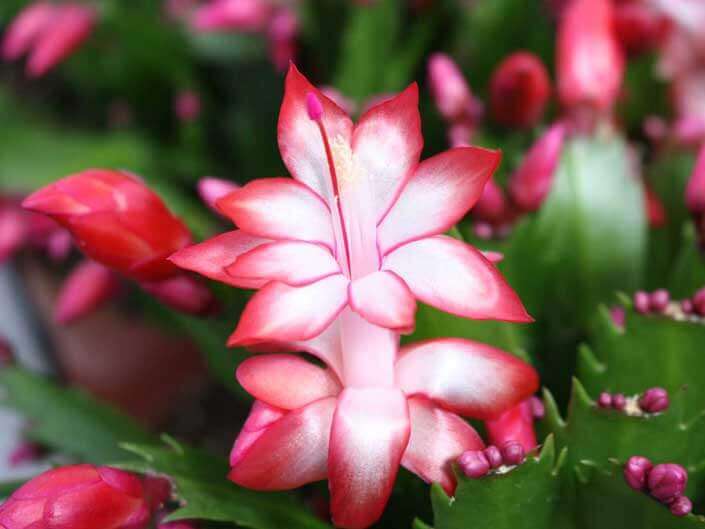
Schlumbergera 'Exotic Red Lip' is a Christmas cactus with white flowers edged in cerise red, for a crisp, two-tone show through autumn and winter. Flattened, bright green stem segments arch out and over the pot edge, and as the nights lengthen each segment tip swells into a fat bud that opens to a tubular flower of layered, pointed white petals, each finished with a red edge. It is an easy, long-lived houseplant that will flower again each year with a simple autumn routine. Find more seasonal colour among our flowering houseplants.

Origins

Christmas cacti are jungle cacti from the coastal mountain forests of south eastern Brazil, where they grow on tree trunks and rocks rather than in desert sand. They have no spines and need different care from a desert cactus. Most modern cultivars descend from Schlumbergera truncata, the crab or Thanksgiving cactus with toothed, claw-like segments, and some also have Schlumbergera × buckleyi, the older round-segmented Christmas cactus, in their parentage. In the UK all of them are sold as Christmas cactus. It sits alongside Schlumbergera 'Vida' (orange), Schlumbergera 'Kornelia' (fuchsia pink) and Schlumbergera 'Malissa' (white) in our range, and the spring flowering Easter cactus is a close relative.

Care

Give it bright, indirect light and keep it out of hot midday sun, which scorches the stems. Water when the top few centimetres of compost have dried and never leave it standing in water. Buds form as autumn nights lengthen and cool, so a spot away from lamps that stay on in the evening helps. Once buds appear, leave it where it is, because a move or a sudden change in temperature can make them drop. Keep it above 10C. It is non-toxic to cats and dogs, which makes it one of the easier pet safe houseplants to place.

Live Arrival Guarantee

All plants are covered by our 7-day live arrival guarantee. We pack every order in protective, sustainable packaging designed to keep your plants safe in transit, and every plant is checked before it ships. On the rare occasion something is not right on arrival, we will make it good, provided the plant is still in its original nursery pot.

Find out more

Delivery & returns

Order by 1pm Monday to Friday for same day dispatch. Every plant travels in protective, plant-safe packaging with tracked delivery.

Changed your mind? See our Return Policy.

Best quality plants guaranteed
7 day live arrival guarantee
Delivered to your door with care
Earn 39 points with this plant · 5 points per £1 Join free

How to care for Christmas Cactus

Keep me in bright, gentle light away from harsh sun and water me once my top few centimetres feel dry.

In their words

What our customers say

Arrived just like the photos - maybe even fuller. Healthy, well-acclimated, and straight into my collection with no issues.

Emily P.

Flawless leaves, stunning variegation, and clearly cared for by experts. It’s already a talking point in my home office.

James R.

Hard to find rare plants that are pet-safe. Ours arrived in perfect condition and looks amazing without any worry.

Sophie L.
Get to know me

About Christmas Cactus

Schlumbergera 'Exotic Red Lip' is an easy-care houseplant. It needs bright indirect light, watering once the top 2 to 3cm of compost has dried out, average household humidity and a minimum temperature of 10°C. It is listed as non-toxic to cats and dogs.

Care level

EasyChallenge

Easy care

Light

ShadeFull sun

Bright, indirect light

Bright, indirect light near an east or west facing window suits it best. Keep it out of hot midday sun, which scorches and yellows the stems. Buds form as the days shorten, so from early autumn give it long, unbroken nights of around 13 hours, away from rooms where lamps stay on in the evening. Read moreShow less

Bright, indirect light near an east or west facing window suits it best. Keep it out of hot midday sun, which scorches and yellows the stems. Buds form as the days shorten, so from early autumn give it long, unbroken nights of around 13 hours, away from rooms where lamps stay on in the evening.

Watering

Evenly moistDries out fully

Let the top few centimetres dry out

Water when the top few centimetres of compost feel dry, then let the excess drain away. Keep the compost a little more evenly moist while it is in bud and flower, and never leave the pot standing in water, as wet roots rot. Water more sparingly for a few weeks after flowering. Read moreShow less

Water when the top few centimetres of compost feel dry, then let the excess drain away. Keep the compost a little more evenly moist while it is in bud and flower, and never leave the pot standing in water, as wet roots rot. Water more sparingly for a few weeks after flowering.

Humidity

Average homeHigh humidity

Happy at normal household humidity

Average room humidity is fine, though it appreciates a little extra moisture in the air. In a dry, centrally heated room, grouping it with other houseplants helps. Read moreShow less

Average room humidity is fine, though it appreciates a little extra moisture in the air. In a dry, centrally heated room, grouping it with other houseplants helps.

Temperature

Keep above 10°C · Happy at normal room temperature

Normal room temperatures of around 18 to 20C suit it in spring and summer. A cooler, slightly drier spell in autumn, a few degrees lower, helps it set buds. Keep it above 10C. Once in bud, avoid moving it or exposing it to sudden changes in temperature, which cause bud drop. Read moreShow less

Normal room temperatures of around 18 to 20C suit it in spring and summer. A cooler, slightly drier spell in autumn, a few degrees lower, helps it set buds. Keep it above 10C. Once in bud, avoid moving it or exposing it to sudden changes in temperature, which cause bud drop.

Feeding

Feed monthly with a balanced fertiliser from spring to autumn, and let it rest over winter.

Growth habit

Plant type

Toxicity

Listed as non-toxic to cats and dogs. Plants still are not food, so a determined chewer may get an upset stomach.

Also known as

Schlumbergera 'Exotic Red Lip'

Genus

Schlumbergera
Good to know

Frequently Asked Questions

What is 'Exotic Red Lip'?

'Exotic Red Lip' is the trade name this Christmas cactus is sold under. It does not appear in the Schlumbergera cultivar register, so it is a selling name for a modern cultivar with white flowers edged in red, rather than a registered variety.

Is this a Christmas cactus or a Thanksgiving cactus?

Both names are used for the same group of plants. Strictly, Thanksgiving or crab cactus is Schlumbergera truncata, with toothed, claw-like stem segments, while the older Christmas cactus, Schlumbergera x buckleyi, has rounded segments and flowers later. Most plants sold today are truncata types or hybrids, and in the UK all of them are sold as Christmas cactus.

Why is my Christmas cactus not flowering?

Buds form in response to long nights and cooler autumn temperatures, so a plant kept in a warm room with lamps on every evening often fails to flower. From early autumn, give it a cooler spot with around 13 hours of unbroken darkness a night and slightly less water, and buds usually follow within a few weeks.

Is a Christmas cactus poisonous to cats and dogs?

No. The ASPCA lists Christmas cactus as non-toxic to cats, dogs and horses, so it is a safe choice for a home with pets. Chewed stems can still upset a sensitive stomach, so keep it where pets cannot graze on it.

Why are the buds dropping off?

Bud drop is usually caused by a sudden change: a move to a new spot, a cold draught, a blast of heat or compost that has dried out completely. Once buds have formed, leave the plant where it is and keep the compost lightly moist until flowering is over.

Is this plant safe for my pets?

Yes. This plant is listed as non-toxic to cats and dogs, so it's a good choice for homes with pets. Even so, plants aren't food, so a keen chewer could still get an upset stomach. If you're worried, speak to your vet.

Have a look at our pet safe houseplants collection for more.

Are your plants treated with pesticides?
We aim to avoid using pesticides where possible, but we can't control the whole supply chain.

If the plant is going into a vivarium, terrarium or aquarium with live animals, rinse the leaves and roots well, remove any soil and let the plant dry out before adding it. We'd also suggest keeping it away from animals for a month first.
Can I see a photo of the exact plant I'll receive?
We're not able to send photos of individual plants or let you choose a specific one, as plants are selected by our team when your order is packed. Our photos show the variety and the kind of plant you can expect, and yours may vary a little in height, shape or fullness.

If a size has a code next to it, such as 9cm / B2, you're buying the exact plant pictured.
Does my plant come with a pot?
Your plant will arrive in its nursery grow pot — the plastic pot it's been growing in. We don't include a decorative pot as standard, and there's a good reason for that: it means you get to choose one that fits your space and style, rather than being stuck with something that doesn't suit your home.

It also means you're not paying extra for a pot you might not want. The nursery pot is perfectly fine to keep your plant in for a while, just pop it inside a decorative cover pot or cache pot and you're good to go. When you're ready to repot (usually after a growing season or when roots start poking out the bottom), you can move it into something more permanent with fresh soil.

If you're not sure what size cover pot to go for, check the pot selector tool listed above, you'll want a decorative pot that's a centimetre or two wider than that to give it a comfortable fit.
How big will my plant be when it arrives?
Every plant on our site includes the pot size (e.g. 12cm) and, where possible, an approximate height. That's the most reliable way to set your expectations, photos can sometimes make a plant look larger or smaller than it really is.

If you're thinking "that sounds quite small for the price," here's something worth knowing: younger, smaller plants almost always adapt better to your home than larger ones. They adjust faster to your light and humidity, put out new growth more quickly, and tend to establish stronger root systems long-term. A plant that grows into your space will usually outperform one that was already big when it arrived.

That said, every plant is an individual. The one you receive may vary slightly in height, shape, or fullness compared to the photo, that's the nature of living things, not a quality issue. We select healthy, well-established specimens, and if you ever feel your plant doesn't match what you were expecting, just get in touch and we'll take a look.
What makes your plants different from the supermarket or garden centre?
There's a big difference between a plant that's been sitting under on a retail shelf and one that's been looked after and cared for by people who specialise in exactly this.

Our plants are grown in house or sourced from specialist nurseries, many of them varieties you simply won't find at your local garden centre or supermarket. Before anything leaves us, it's checked over by our horticultural team to make sure it's healthy, well-rooted, and ready to thrive in your home. We're not shifting volume off a pallet, we're choosing plants we'd want to keep ourselves.

When you buy from a supermarket, you get a plant and a generic care label. When you buy from us, you get the knowledge that comes with it, detailed care guidance, a team you can actually contact if something isn't going right, and the confidence that what's arriving has been looked after properly from the moment it was grown to the moment it reaches your door.

We're a specialist nursery first, not a retailer that happens to sell plants. That's the difference, and you'll see it the moment you open the box.
What should I do when my plant arrives?
First things first, unbox it as soon as you can. Plants don't love being in dark boxes any more than you would, and the sooner yours is out and breathing, the better.

Remove all the packaging carefully, give the soil a check with your finger, and water lightly if it feels dry. Then find it a spot with appropriate light, but avoid putting it straight into harsh direct sun or next to a radiator. Think of it like arriving somewhere new after a long journey: it needs a moment to adjust.

It's completely normal for your plant to look a little tired or droopy after transit. This is called transit stress, and most plants bounce back within a week or two. You might see a yellow leaf or some drooping, don't panic, and resist the urge to overwater or start repotting straight away.

Our advice for the first couple of weeks: leave it in its nursery pot, water it only when the top layer of soil feels dry, and let it acclimatise to your home's light, temperature, and humidity. Once it's settled in and showing signs of new growth, you can think about repotting or moving it to its permanent spot.

Every plant we sell comes with a care guide on the product page so you'll know exactly what it needs going forward. And if anything doesn't look right, get in touch with our team, we're always happy to help.
Will my plant survive being shipped?
Yes! and we go to serious lengths to make sure of it. Every plant is hand-packed by our team with protective wrapping and secure, custom-designed boxes to keep it stable and safe in transit. We've shipped hundreds of thousands of plants across the UK and our packaging methods have been refined over years to handle the bumps and jolts of delivery.

During colder months, we monitor weather forecasts and offer heat packs where needed to protect against frost. In extreme conditions, we may hold your order for a day or two rather than risk sending it out, we'd rather you wait an extra day than receive a stressed plant.

That said, plants are living things, and the occasional transit wobble can happen. If your plant arrives damaged or isn't in the condition you'd expect, just get in touch within 7 days with a photo, and we'll make it right, whether that's a replacement or a full refund. No fuss.

The short version: we treat every box like it's going to someone who really cares about what's inside, because it is.
Meet the family

Everything about Schlumbergera

Successful Christmas cactus care comes down to two key details: providing a cooler, drier rest in autumn to encourage flowering, then water consistently once flower buds appear. Get these key steps right, and your Christmas cactus should reward you with bea...

More about Schlumbergera care
Schlumbergera Care Guide
Why Grow Tropicals

Plants delivered the way they deserve

Packaged with Care

Packaged with Care

Every order is hand-packed in eco-friendly, protective packaging - refined through thousands of deliveries to ensure your plant arrives healthy, hydrated, and looking its best.

Backed by our Live Arrival Guarantee.

Perfect for Gifting

Perfect for Gifting

From rare collector’s pieces to easy-care favourites, our plants arrive fully potted and ready to enjoy. Add a personalised note at checkout for a thoughtful finishing touch.

Delivered fresh, beautiful, and gift-ready.

Sustainability at Heart

Sustainability at Heart

All plants are ethically sourced from trusted growers, never wild-collected. Every order ships carbon-neutral in minimal-waste packaging.

Good for your home - and the planet.

Verified reviews

Rated by real customers

You may also like

We recommend

Schlumbergera 'Exotic Red Lip'
£7.99