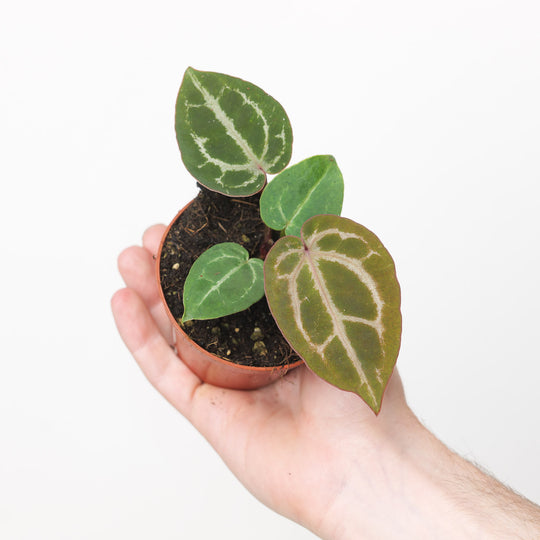
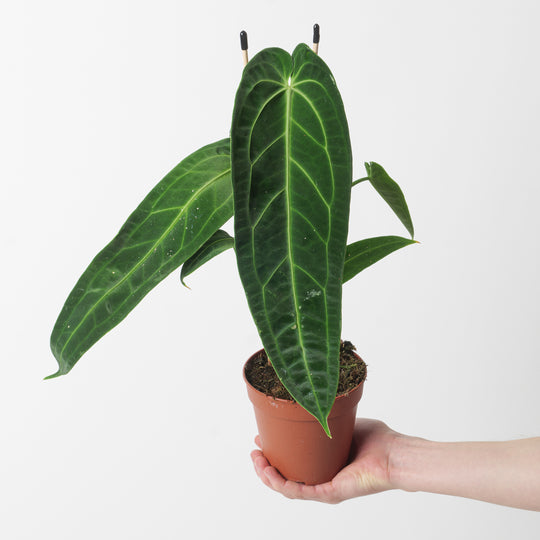
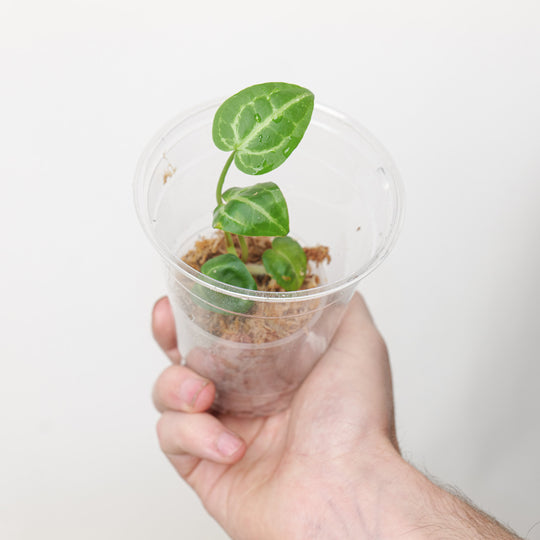
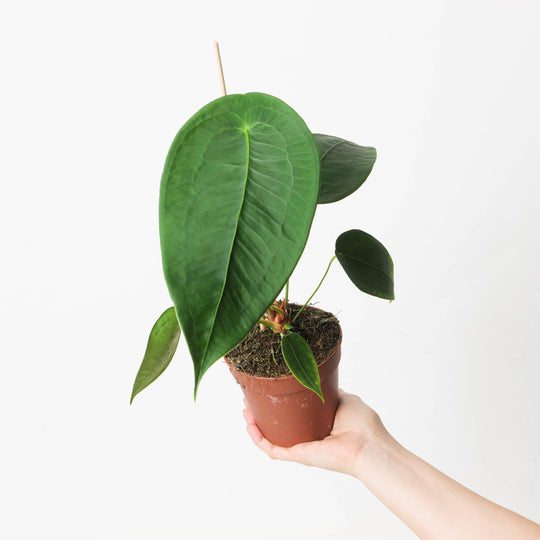
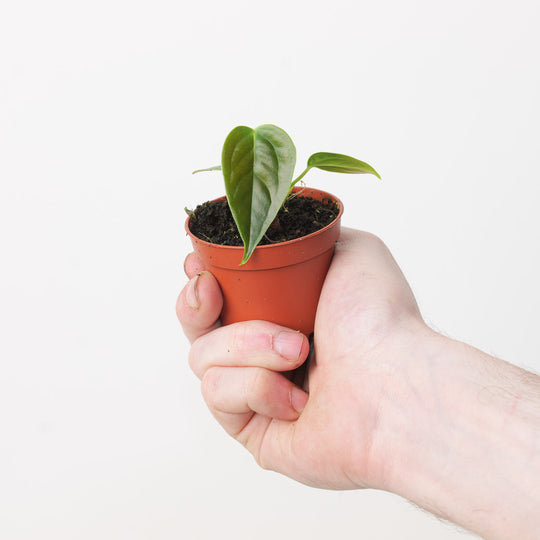
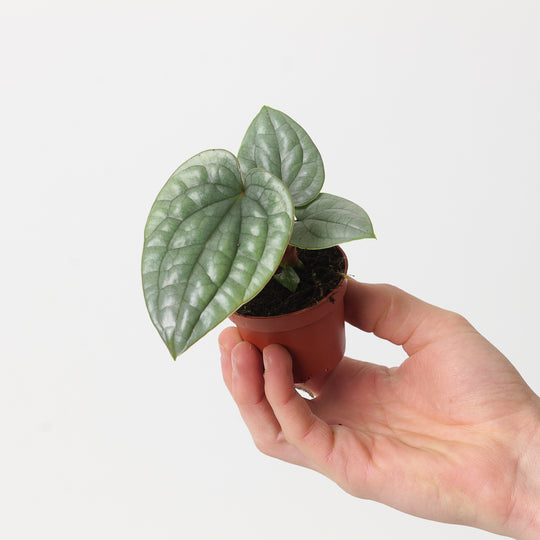
Velvet Anthurium
Anthurium Care Guide for Foliage Anthuriums

If you're growing for huge, velvet leaves and deep venation, foliage Anthuriums require a slightly different approach than the standard flowering Anthurium care guide.
Popular foliage species like Anthurium regale, A. warocqueanum, and A. crystallinum still want warmth, humidity, and an airy root zone, but the biggest thing that separates them is that they reward consistency far more than intensity. In practice: bright but filtered light, a substrate that stays moist without going dense, and a feeding routine that's steady rather than heavy.
We've grown foliage Anthuriums in our nursery for years, and most of the mistakes we see, and have made ourselves, come down to chasing extreme conditions rather than keeping stable ones.
What foliage Anthuriums actually need
Keep four things stable and you're most of the way there:
- Bright indirect light, not harsh sun
- Warm temperatures with no cold drafts or sudden swings
- High humidity with good airflow
- Loose, oxygen-rich roots that never sit in stale, compacted media
That's it. It sounds technical, but once your setup matches the plant, it becomes a routine rather than a balancing act. A bright room can work beautifully. A grow tent can work even better. The key is choosing an environment you can actually maintain week after week.
The short version: foliage Anthuriums don't need a perfect jungle. They need a repeatable routine.
Growing foliage Anthuriums in a normal home
A standard home setup is genuinely a good place to start with easier species like Anthurium clarinervium and Anthurium magnificum. It's easier to manage and less expensive to set up.
Most foliage Anthuriums prefer bright, indirect light. In our experience, a north or east-facing window works well, or diffused light from a brighter window with a sheer curtain in front of it. For the plants specifically, that usually means:
- An east-facing window
- A few feet back from a south or west window
- No direct midday sun on the leaves
- Nothing near a radiator, cold window pane, or heating vent
You're not trying to recreate a greenhouse. You're trying to avoid extremes. A stable, bright room will usually grow a better crystallinum than a dim corner with a humidifier beside it.
Humidity and temperature
We aim for 60-80% humidity for our Anthuriums. Below around 60%, you'll start to see stress, especially in warocqueanum, which tends to be the first to complain when the air dries out. Anthurium crystallinum usually adapts faster. Anthurium regale tends to care more about stable warmth and root moisture than atmospheric humidity.
For temperature, aim for 18-28°C and avoid anything below 16°C sustained. Cold draughts are more damaging than people realise; a window that's fine in summer can cause real problems in January.
Practically, in a home:
- Put the plant in the warmest bright room, not the coldest windowsill
- Add a humidifier if your air gets dry in winter
- Improve airflow rather than just trapping the plant in stagnant wet air
- Grouping plants together raises ambient humidity without any extra kit
The best upgrade in most home setups isn't more watering. It's better light plus steadier humidity.
Watering
Water when the top inch of the mix feels dry. Water thoroughly, let the excess drain properly, and then wait until the upper layer starts to dry again before you water. Keep the root zone evenly moist, never swampy.
If the mix is staying wet for too long, that's usually a substrate or pot issue, not a watering issue. A chunky, fast-draining mix helps enormously here.
Growing foliage Anthuriums in a grow tent
For serious collectors, a grow tent makes Anthuriums genuinely easier to manage. You cut out seasonal swings and get much tighter control over humidity, airflow, and light.
A well-set-up tent is especially useful for:
- Anthurium warocqueanum and other velvety and trickier species appreciate consistently higher ambient humidity
- Seedlings and recently imported plants that need a more controlled environment
- Getting through dark UK winters without the plant going backwards
A practical tent setup
For even light distribution, we use strip lights, either T5 or T8 strength, depending on shelf spacing and heat output. Strip lights mounted on the ceiling and under each shelf are far better than a single source, which tends to cause petiole stretching as plants reach toward the light. We've seen this plenty of times; it's very fixable, but it's easier to avoid.
A strong Anthurium tent setup:
- Strip grow lights for even spread across shelves
- Chrome mesh racking or similar
- An inline fan for constant air exchange
- A humidifier
- A light meter so you're measuring at leaf level, not at ceiling level
- Either a chunky soil mix or a semi-hydro setup, more on both below
If your leaves keep leaning to one side, that's almost always a light distribution issue, not a lack of light.
Light deep-dive: natural vs artificial
Natural light
Natural light is still excellent for foliage Anthuriums, but placement matters. Direct sun will scorch velvet leaves quickly. A practical rule of thumb:
- East-facing window: usually ideal
- South or west window: good if filtered by a sheer curtain or set well back from the glass
- North window: workable if very bright; less reliable through a UK winter
- Direct midday sun: avoid, especially on velvet foliage
If you're seeing smaller leaves, longer petioles, and slow growth, the plant needs more light. If the surface looks bleached, crisp, or faded, back off the light.
Artificial light
For foliage species, we target lower light levels than you might expect. This Granthuriums guide is the most useful reference we've found for this, and his targets for velvet Anthuriums are:
- Seedlings and deep-shade species: 150-200 foot-candles
- Species that can handle a bit more: 200-300 foot-candles
- More mature, stronger foliage growers: 300-400 foot-candles
If you're working in PPFD, those ranges land roughly between 22-80 µmol/m²/s depending on your light source and spectrum. We run our grow lights 12 hours a day in darker months, positioned 30-45cm above the plant.
Anthuriums respond better to even, gentle light for longer hours than to one intense spotlight.
Best substrate for foliage Anthuriums
Soil-grown
If you're growing in a soil-based mix, the goal is a substrate that stays moist but airy: excellent drainage, good structure, and enough moisture retention to avoid constant drying out.
Our Anthurium Premium Potting Mix is built specifically for this. It's a peat-free blend of bark, charcoal, coco husk and pumice, with worm castings for natural fertility. That combination gives the long-lasting structure and drainage that velvet Anthuriums love.
Regale, crystallinum, and warocqueanum all want a root zone with high airflow, fast drainage, enough moisture retention to avoid stress, and structure that holds up over months. That mix covers all of it.
Semi-hydro: Pon and LECA
For collectors wanting a more controlled setup, semi-hydro is worth considering. The key is using non-wick self-watering systems. Wick-style pots can create inconsistent moisture and stay too wet in the centre, which causes exactly the problems you're trying to avoid.
Pon has a few real advantages: predictable moisture levels, cleaner root observation, fewer fungus gnats than soil-based media, and better compatibility with self-watering containers. Particle size matters; aim for around 6mm average, which gives good capillary contact around the roots without compaction.
LECA can also work well, especially if you're already comfortable with reservoir feeding. Pon is generally the easier entry point for velvet Anthuriums because of that finer capillary contact.
If you're switching from soil to semi-hydro, transition a healthy plant first, not a struggling one.
Feeding foliage Anthuriums
The weakly weekly approach
The safest general approach for Anthuriums is weakly weekly: a complete fertiliser at low strength, every watering, during active growth. The idea is that you're maintaining a steady, gentle nutrient supply rather than big infrequent feeds that spike and then drop off. Reduce feeding in winter or in lower light conditions when the plant isn't actively growing.
LGL and Shogun
We tend to use LGL fertiliser or Shogun Coco 2-part fertiliser as the foundation of our feeding programme. For foliage Anthuriums, the NPK balance matters:
- Nitrogen (N) drives leaf and stem development. This is exactly what you want from a foliage plant, and it's what pushes those big, rich leaves.
- Phosphorus (P) supports root development and energy transfer. You don't want it too high on a foliage plant, as excess P can suppress some micronutrient uptake.
- Potassium (K) supports overall plant health, stress tolerance, and cell structure, including that thick, firm leaf texture you're chasing.
We also recommend including additional calcium and magnesium support in your feeding from a CalMag product. This matters because velvet Anthuriums can show deficiencies, interveinal yellowing and weak new growth, when Ca and Mg are low, particularly in soft water areas. If you're growing in semi-hydro, we'd also recommend adding a bioprotectant to keep the reservoir clean and/or flushing regularly.
For dilution, follow the label guidance and if in doubt, go half strength. A slightly hungry Anthurium is easy to fix. One with fertiliser salt burn at the roots is not.
What overfeeding looks like
Brown leaf tips and edges are often attributed to low humidity, but overfertilisation is just as common a cause, especially in pots where salts build up over time. If your Anthurium has brown margins and the roots are otherwise healthy, check your fertiliser strength before looking for a more exotic explanation. Flushing the pot with plain water every few weeks helps manage salt accumulation.
A slightly hungry Anthurium is always easier to fix than an overfed one.
Propagation
For home growers, division, stem cuttings, and seed are the most practical options:
- Division: split a mature plant that has multiple growth points and a healthy root mass. This is the lowest-risk method.
- Stem cuttings: only when there's a clear node and enough humidity to support rooting. Don't try this on a weak or recently imported plant.
- Seed: slower and more involved, but genuinely rewarding. Anthurium seeds need to be sown fresh, they lose viability quickly once dry, onto a moist, well-aerated mix, with high humidity and warmth, around 24-26°C, throughout germination. Expect several weeks before seedlings emerge. It's a long game, but it's how you end up with plants that are genuinely yours from the start.
Propagate when the plant is actively growing, not when it's stalled or recovering.
Common problems
Yellow leaves - most often overwatering, poor drainage, or low humidity. Start with those three before looking elsewhere.
Brown tips - usually low humidity or fertiliser salt build-up. Especially common in winter in dry, heated rooms.
Long petioles, small leaves - a light issue. The plant is stretching toward the source. Increase light or improve distribution.
Faded velvet, crisp patches - too much light. If your velvet foliage is losing its richness or crisping at the edges, back off the light before you change anything else.
Always judge the plant by its newest leaf. That's the one that tells you whether your setup is working.
Final thoughts
The best care routine for foliage Anthuriums isn't the most technical one. It's the most consistent one.
In a normal home, that usually means bright indirect light, a premium open mix like our Anthurium Premium Potting Mix, careful watering, and gentle steady feeding with LGL at the right dilution.
In a collector setup, it means measured light, controlled humidity, good airflow, and often semi-hydro or our Anthurium Potting Mix.
Either route can produce spectacular foliage, as long as the roots stay airy and the environment stays consistent. That's really the whole game.