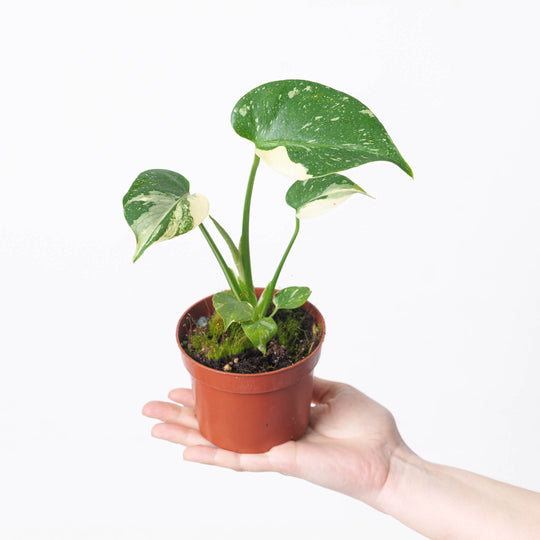
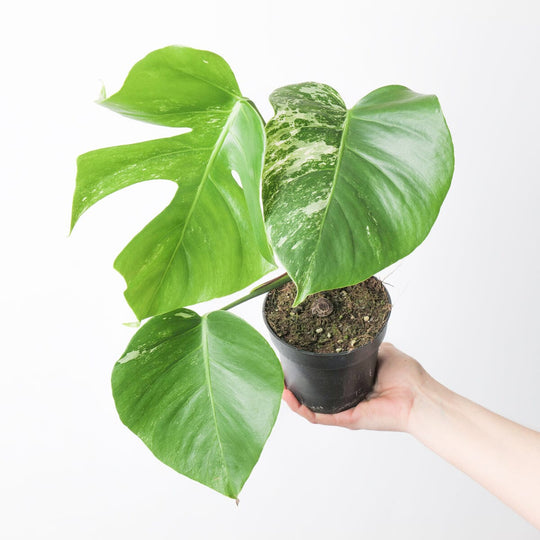
Swiss Cheese Plant
Monstera Care Guide

Monstera deliciosa is one of the most popular houseplants in the UK, and for good reason. It's tolerant, fast-growing, and develops those distinctive fenestrated leaves that make it such an iconic plant. But "easy" doesn't mean "thrives on neglect," and most monstera plant care problems come down to light, watering, or support.
This guide covers everything you need to know about Monstera deliciosa care, from getting the basics right in a normal home to troubleshooting common problems. Whether you're growing your first swiss cheese plant or trying to get bigger, more fenestrated leaves from one you've had for years, the principles are the same: bright light, an airy root zone, consistent watering, and something to climb.
What monstera actually needs
Monstera deliciosa is a hemiepiphyte. In the wild, it starts life on the forest floor and climbs toward the canopy, rooting into trees as it goes. That climbing habit explains most of what you need to know about its care:
- Bright indirect light. It's reaching for the canopy. More light means bigger leaves with more fenestration.
- Something to climb. Aerial roots aren't decorative; they're functional. A supported monstera grows bigger, faster.
- An airy, well-draining substrate. In nature, the roots grip bark and moss, not compacted soil.
- Consistent moisture without waterlogging. The root zone should be moist and oxygenated, never swampy.
Get those four things right and a monstera will reward you with fast, healthy growth. Most problems trace back to one of these being off.
The short version: bright indirect light, a moss pole, chunky soil, and water when the top couple of inches dry out.
Light
Light is the single biggest factor in how your monstera grows. More light means larger leaves, more fenestrations (the distinctive holes and splits), and a more compact, bushy plant. Too little light and you'll get smaller leaves, long leggy stems, and no splits at all.
Monstera light requirements
- East-facing window: usually ideal. Morning sun is gentle enough not to scorch.
- South or west window: excellent if set a couple of feet back from the glass, or filtered by a sheer curtain. Direct afternoon sun through glass can burn leaves.
- North-facing window: workable in summer, but often not enough through a UK winter. If growth stalls from October to March, light is almost certainly the reason.
A monstera can survive in lower light, but it won't thrive. If your plant is producing leaves without fenestrations, or the gaps between leaves (internodes) are getting longer, it needs more light.
Can Monstera take direct sunlight?
A little morning sun is fine. Direct midday or afternoon sun through a south or west-facing window will scorch the leaves, especially in summer. Dappled or filtered light is the sweet spot.
If you're using grow lights, aim for around 200 to 400 foot-candles at leaf level, running 12 to 14 hours a day. That range produces strong growth without light stress.
Watering
Monstera watering depends on your pot size, substrate, temperature, and light levels, so there's no universal schedule for how often to water monstera. The method that works is checking the soil.
Water when the top 5cm (2 inches) of soil feels dry. Push your finger into the mix. If it feels moist, wait. If it feels dry, water thoroughly until it runs from the drainage holes, then let the excess drain completely. Don't leave the pot sitting in a saucer of water.
In practice:
- Spring and summer (active growth): every 7 to 10 days for most homes.
- Autumn and winter: every 10 to 14 days, sometimes longer. Growth slows, so the plant uses less water.
- In a terracotta pot: more frequently than in plastic, because terracotta is porous and dries faster.
Signs of overwatering
Yellow leaves on a monstera are the most common complaint, and overwatering is the most common cause. If the lower leaves are turning yellow and the soil feels damp, you're watering too often or the substrate isn't draining fast enough.
Other signs: soft, mushy stems near the base; a musty smell from the soil; or black, mushy roots when you unpot. If you catch it early, let the soil dry out fully, check the drainage, and consider repotting into a chunkier mix.
Signs of underwatering
Drooping, curling leaves that perk up after watering. Brown, crispy leaf edges (though this can also be low humidity). Soil pulling away from the sides of the pot. Underwatering is easier to fix than overwatering: give it a good soak, and adjust your schedule.
Humidity and temperature
Monstera is more tolerant than most tropical houseplants when it comes to humidity. Standard UK home humidity (40 to 60%) is usually fine, especially for mature plants. You'll see the best growth above 50%, and if your home drops below 40% in winter (common with central heating), the leaf edges may start to brown.
Practical ways to raise humidity:
- Group your plants together. Each one transpires moisture, raising the ambient level.
- Use a pebble tray filled with water beneath the pot.
- Place the plant in a naturally humid room: a bright bathroom or kitchen.
- For serious humidity control, add a humidifier near your plants.
Temperature: 18 to 27°C is the comfortable range. Monstera can handle brief dips to around 15°C, but sustained cold or draughts will stall growth and can cause leaf damage. Keep it away from cold windowpanes in winter and radiators year round.
Best soil for Monstera
In the wild, Monstera roots cling to bark and organic debris on tree trunks. They want oxygen and drainage. A dense, water-retentive compost is the fastest way to cause root rot.
The best soil for monstera is a chunky, well-draining aroid mix. Our Philodendron and Monstera Potting Mix is formulated specifically for this. It's a peat-free blend of bark, perlite, coco coir, and charcoal that gives the drainage and airflow monstera roots need, while retaining enough moisture to keep the plant happy between waterings.
If you're mixing your own, aim for roughly:
- 40% bark (orchid bark or pine bark, medium grade)
- 25% perlite or pumice
- 20% coco coir
- 10% horticultural charcoal
- 5% worm castings for gentle fertility
The goal is a mix that drains within seconds when you water, but doesn't dry out completely within a day or two. If your current monstera soil stays wet for more than a week after watering, it's too dense.
Support: moss poles and aerial roots
Monstera support is one of the most overlooked aspects of care. A monstera without it will eventually flop, sprawl, and produce smaller leaves. In the wild, it climbs trees. In your home, it needs a monstera moss pole or similar climbing support to do the same thing.
Why support matters: when a monstera climbs, its aerial roots attach to the pole and draw moisture from the moss or coir. This triggers the plant to produce larger leaves with more fenestrations. A well-supported monstera can produce leaves two to three times the size of an unsupported one. It's the single most transformative thing you can do for an established plant.
Monstera aerial roots
Those thick, brown roots growing from the stem aren't a problem. They're exactly what the plant is supposed to produce. In nature, they anchor the plant to trees and absorb moisture and nutrients.
What to do with them:
- If the plant has a moss pole: guide the aerial roots into the moss. Keep the moss damp and the roots will attach and feed.
- If the plant doesn't have support yet: leave them. Don't cut them off. They're not harming anything, and they'll be useful when you do add a pole.
- If they're very long and trailing: you can tuck them back into the pot or gently wrap them around a support. Avoid cutting healthy aerial roots unless absolutely necessary.
Choosing a support
Coir or moss poles are the most effective because aerial roots can actually grip and root into the material. Bare wooden stakes or smooth bamboo canes give the plant something to lean against but don't encourage rooting. We stock a range of moss poles and plant supports in different sizes.
Feeding
During the growing season (spring through early autumn), feed your monstera monthly with a balanced liquid fertiliser diluted to the recommended strength. We use LGL fertiliser for our monstera stock. It provides a solid NPK balance along with the micronutrients that support healthy leaf development.
A few guidelines:
- Don't feed in winter. Growth slows significantly and unused fertiliser salts build up in the soil.
- Don't overfeed. Monstera brown tips are often blamed on humidity, but fertiliser salt build-up is just as common a cause. If you see crispy brown edges and the roots look healthy, reduce your feeding or flush the soil with plain water.
- Weakly weekly works too. Some growers prefer a quarter-strength feed with every watering during active growth. Either approach is fine as long as you're not overdoing it.
Repotting
Repot your monstera when roots are circling the bottom of the pot or growing heavily out of the drainage holes. For most plants, that's every one to two years.
When to repot: spring or early summer, when the plant is actively growing. Avoid repotting in winter: the plant is semi-dormant and slower to recover.
Pot size: go up one size only (roughly 5cm / 2 inches wider in diameter). A pot that's too large holds excess moisture around the roots, which increases the risk of root rot.
How to repot Monstera, step by step:
- Water the plant a day or two before repotting. Moist roots are easier to work with and less prone to damage.
- Gently remove the plant from its current pot. Tease apart any circling roots.
- Place it in the new pot with fresh monstera potting mix around and beneath the root ball.
- If the plant has a moss pole, insert it now, before filling with substrate.
- Water thoroughly and let it drain.
- Don't feed for two to three weeks after repotting. Fresh substrate has enough nutrients to get the plant started.
How to propagate Monstera
Monstera propagation is straightforward, which is part of why the plant is so popular. The most reliable method is stem cuttings.
Stem cuttings (the standard method)
- Choose a healthy stem with at least one node (the slightly raised bump where a leaf meets the stem) and one or two leaves. Aerial roots near the node are a bonus but not essential.
- Cut below the node with a clean, sharp blade. The node is where new roots will grow.
- Root in water or sphagnum moss. Water is simpler: place the cutting in a jar so the node is submerged but the leaf stays above water. Change the water weekly. Sphagnum moss is slightly faster: wrap damp moss around the node and keep it in a sealed bag or propagation box to hold humidity.
- Wait for roots. You'll typically see roots in two to four weeks. Once they're around 5cm long, pot the cutting into a chunky aroid mix.
Air layering
For larger or more valuable plants where you don't want to cut first, air layering lets you trigger root growth while the cutting is still attached to the mother plant. Wrap damp sphagnum moss around a node with an aerial root, cover it with cling film, and wait for roots to develop inside the moss. Once well-rooted, cut below the moss ball and pot up.
When to propagate: spring or early summer, when the plant is in active growth. Avoid propagating a weak, stressed, or recently repotted plant.
Common monstera problems
Monstera yellow leaves
The most searched monstera problem, and usually the simplest to diagnose. Work through these in order:
- Overwatering or poor drainage. By far the most common cause. Check the soil: if it's damp and heavy, let it dry out and consider switching to a chunkier mix.
- Low light. A monstera in a dim corner will gradually yellow its lower leaves as it can't sustain them.
- Natural ageing. The occasional oldest leaf turning yellow and dropping is normal. It's only a concern if multiple leaves are yellowing at once.
- Root rot. If the stem feels soft at the base and the roots are dark and mushy, the problem has progressed beyond simple overwatering. Unpot, trim the rotten roots, and repot in fresh substrate.
Monstera brown tips
Brown, crispy leaf tips and edges are usually caused by:
- Low humidity, especially in winter when central heating dries the air
- Fertiliser salt build-up in the soil (flush with plain water every few weeks)
- Underwatering or inconsistent watering
Leaves without fenestrations
If your monstera is producing solid, un-split leaves, it almost certainly needs more light. Monstera fenestration develops as the plant matures and is strongly correlated with light levels. A young plant may not fenestrate regardless of conditions, but a mature plant in good light should.
Support also plays a role. A climbing monstera receiving good light will fenestrate earlier and more dramatically than one trailing along the ground.
Monstera drooping
Drooping is usually a watering issue. Check the soil: if it's bone dry, give it a good soak. If it's wet, the roots may be struggling. In rare cases, drooping after repotting is transplant stress and resolves on its own within a week or two.
Pests
Monstera is relatively pest-resistant, but keep an eye out for:
- Thrips: tiny elongated insects that leave silvery streaks on leaves. Treat with a systemic insecticide or neem oil.
- Spider mites: fine webbing on the undersides of leaves, usually in dry conditions. Increase humidity and treat with an appropriate miticide.
- Fungus gnats: small flies around the soil surface. Usually a sign the substrate is staying too wet. Let it dry out more between waterings.
Other Monstera species we grow
Everything above applies primarily to Monstera deliciosa, but the genus is much broader than that. We grow a range of Monstera species in our nursery, and while the core care principles are the same (bright indirect light, chunky substrate, consistent watering), each has its own quirks. Here's what to know about the species you'll find in our Monstera collection.
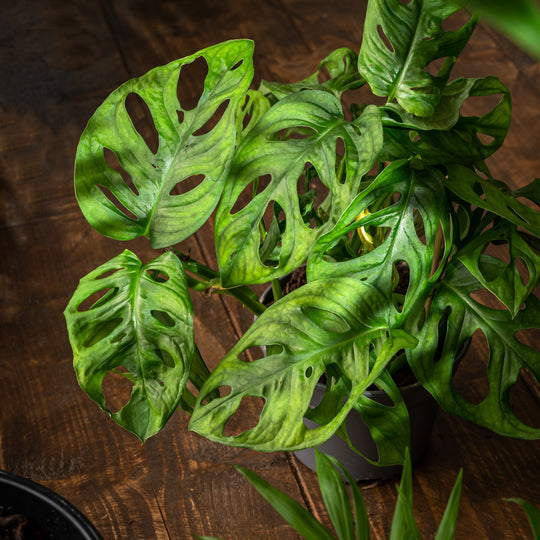
Monstera adansonii care (Swiss Cheese Vine)
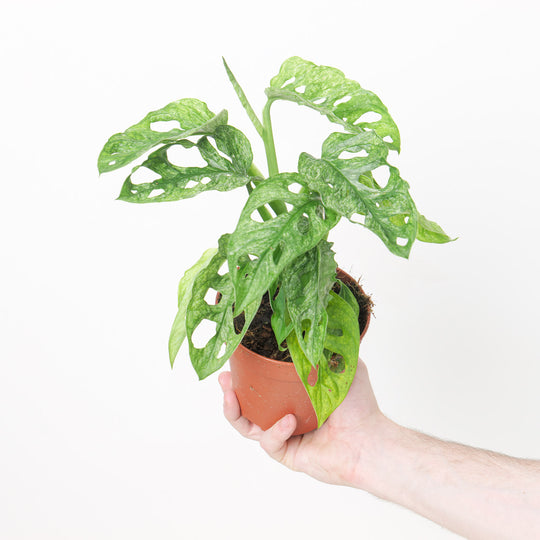
Monstera adansonii, sometimes called the monkey mask monstera or swiss cheese vine, is a smaller, trailing species with heavily fenestrated oval leaves. Unlike M. deliciosa, which tends to grow upright with a single thick stem, adansonii produces thinner, more flexible vines and works beautifully in a hanging pot or trained up a small moss pole.
Monstera adansonii care follows the same principles as deliciosa, but there are a few differences worth noting. It's slightly more sensitive to overwatering because its roots are finer and the stems hold less moisture. Water when the top few centimetres of soil are dry, and make sure the mix drains quickly. It also appreciates slightly higher humidity than deliciosa and is one of the first plants to show crispy leaf edges in dry winter air. A humidifier nearby makes a noticeable difference.
For monstera adansonii propagation, the method is identical to deliciosa: cut below a node, root in water or moss. The main difference is that adansonii roots faster, often within 10 to 14 days. If you're seeing monstera adansonii yellow leaves, check for overwatering first, then light levels. It needs bright indirect light but tolerates slightly less than deliciosa before showing stress.
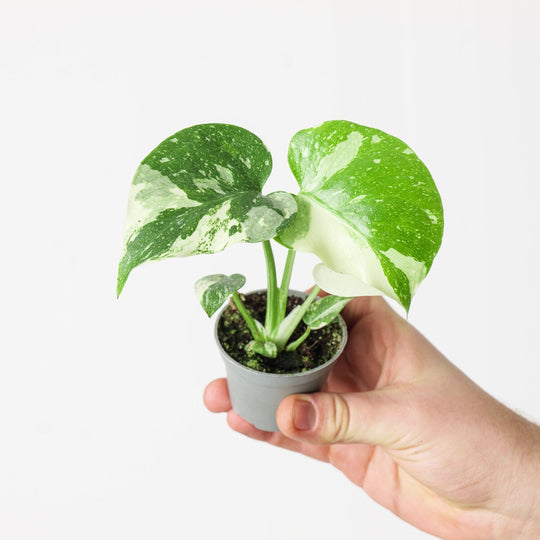
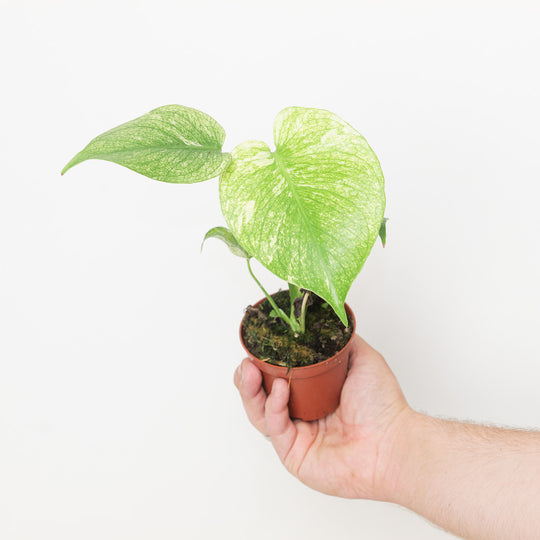
Monstera Thai Constellation care
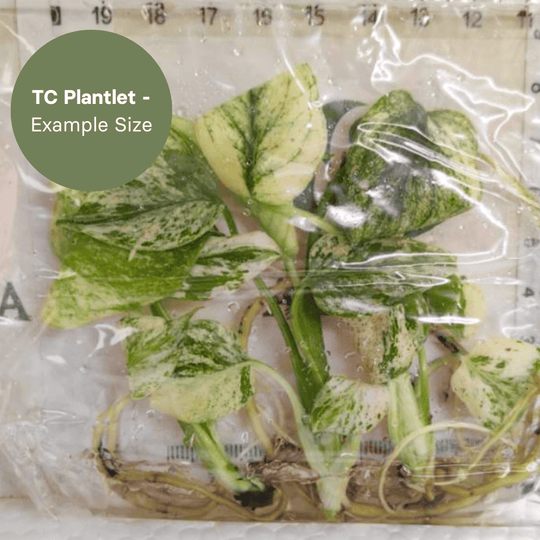
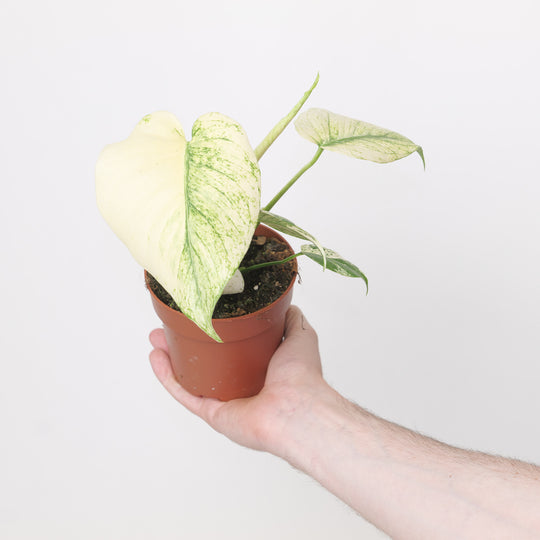
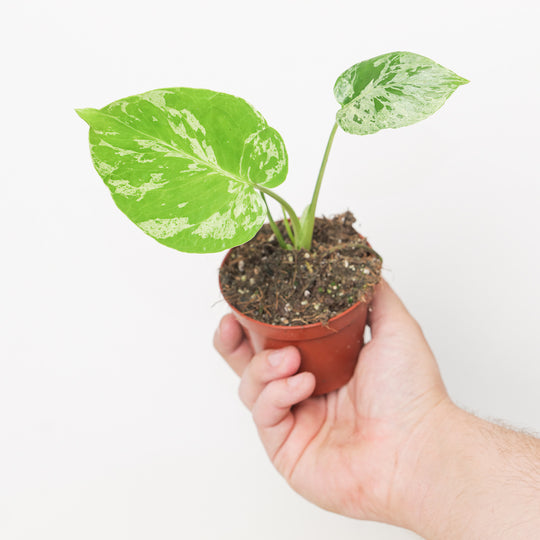
The Monstera Thai Constellation is a tissue-cultured variegated form of M. deliciosa with stable cream and green patterning. It's one of the most sought-after houseplants, and we produce ours from tissue culture in our nursery.
Monstera Thai Constellation care is essentially the same as standard deliciosa, with one key caveat: variegated plants photosynthesise less efficiently because the cream sections contain little to no chlorophyll. This means they grow more slowly and need more light than a fully green deliciosa to compensate. A bright east or south-facing window (filtered) is ideal. In lower light, the plant will push out more green to compensate, and growth slows significantly.
The same light sensitivity applies to watering: because the plant grows more slowly, it uses water more slowly. Adjust your schedule accordingly and err on the side of slightly drier rather than wetter. Feed at half the strength you'd use for a green deliciosa, as the lower growth rate means less nutrient demand.
Monstera Albo care
The Monstera Albo Variegata is the other major variegated deliciosa. Unlike the Thai Constellation's speckled cream, the Albo produces bolder blocks and half-moon patterns of pure white against deep green. It's stunning, but the white tissue is more delicate and prone to browning.
Variegated monstera care for the Albo follows the same rules as the Thai Constellation: more light to compensate for less chlorophyll, careful watering to avoid root stress, and lower fertiliser strength. The extra consideration with Albo is that the white sections are more susceptible to sunburn and browning, so while it needs bright light, be cautious with any direct sun. The white tissue also browns faster in low humidity, so keeping it above 50% makes a real difference to leaf quality.
Monstera Burle Marx Flame care
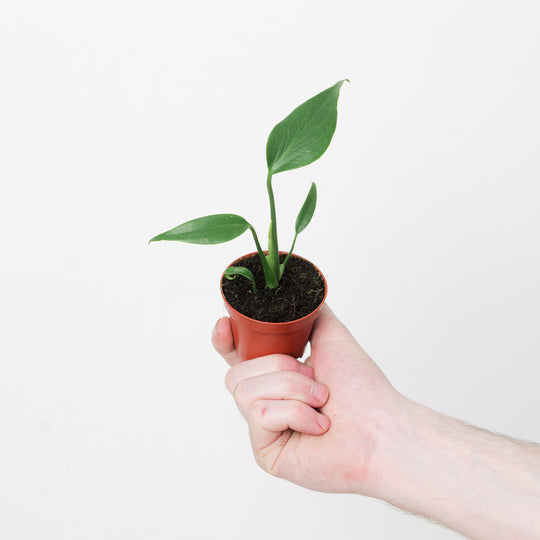
Monstera Burle Marx Flame is a compact, climbing species with narrow, textured, dark green leaves that emerge with a distinctive ruffled edge. It's a much smaller plant than deliciosa at maturity, making it well suited to shelves and smaller spaces.
Care is straightforward: bright indirect light, a chunky aroid mix, and consistent watering. It's a hemiepiphyte like all Monstera, so it benefits from a small moss pole or coir support. Monstera Burle Marx Flame care is relatively forgiving, and the plant copes with slightly lower light better than most variegated Monstera, though growth will slow. One thing to note: it doesn't like sitting in wet substrate. Make sure your pot has good drainage and your mix is open and airy.
Monstera obliqua Peru care
Monstera obliqua Peru is a collector's species and genuinely one of the more demanding Monstera. The leaves are almost entirely fenestration, with thin tissue bridges between holes, which makes them fragile and highly sensitive to dry air. This is not a beginner plant.
Monstera obliqua care requires consistently high humidity (70%+ ideally), warmth, and very careful watering. The roots are fine and rot easily. We grow ours in a very open mix with lots of perlite and bark. A grow tent or grow cabinet is the most reliable home environment for this species, as maintaining the humidity it needs in open air is genuinely difficult in a UK home, especially in winter.
Monstera siltepecana care
Monstera siltepecana has beautiful silver-green lance-shaped leaves in its juvenile form and develops fenestrations as it matures and climbs. It's a versatile species: it trails nicely from a hanging pot when young but really comes into its own when given something to climb.
Monstera siltepecana care is very similar to adansonii. It likes bright indirect light, a well-draining mix, and regular watering. It's slightly more drought-tolerant than adansonii and handles normal home humidity reasonably well. To encourage the adult leaf form (larger, fenestrated), give it a moss pole and good light. Without support, it tends to stay in its juvenile trailing form indefinitely.
Monstera dubia care
Monstera dubia is a shingling species. In its juvenile form, the small, silvery heart-shaped leaves press flat against whatever surface it climbs, creating a striking tiled effect. It's one of the most visually distinctive Monstera species when grown up a flat board or plank.
Monstera dubia care requires a flat climbing surface (a cedar plank or cork board works well), bright indirect light, and moderate to high humidity. It's slower-growing than most Monstera and less tolerant of drying out. Keep the substrate consistently moist but never waterlogged, and consider placing it in a higher-humidity spot or near a humidifier. As it matures and climbs, the leaves eventually grow larger and develop fenestrations, but this transition can take years in home conditions.
Quick species comparison
| Species | Habit | Light | Humidity | Difficulty |
|---|---|---|---|---|
| M. deliciosa | Upright climber | Bright indirect | 40-60% fine | Easy |
| M. adansonii | Trailing / climbing vine | Bright indirect | 50%+ preferred | Easy |
| Thai Constellation | Upright climber | Bright (more than green) | 50%+ preferred | Moderate |
| Albo Variegata | Upright climber | Bright (more than green) | 50%+ preferred | Moderate |
| Burle Marx Flame | Compact climber | Bright indirect | 40-60% fine | Easy |
| M. obliqua Peru | Climber | Bright filtered | 70%+ needed | Advanced |
| M. siltepecana | Trailing / climbing | Bright indirect | 40-60% fine | Easy |
| M. dubia | Shingling climber | Bright indirect | 50%+ preferred | Moderate |