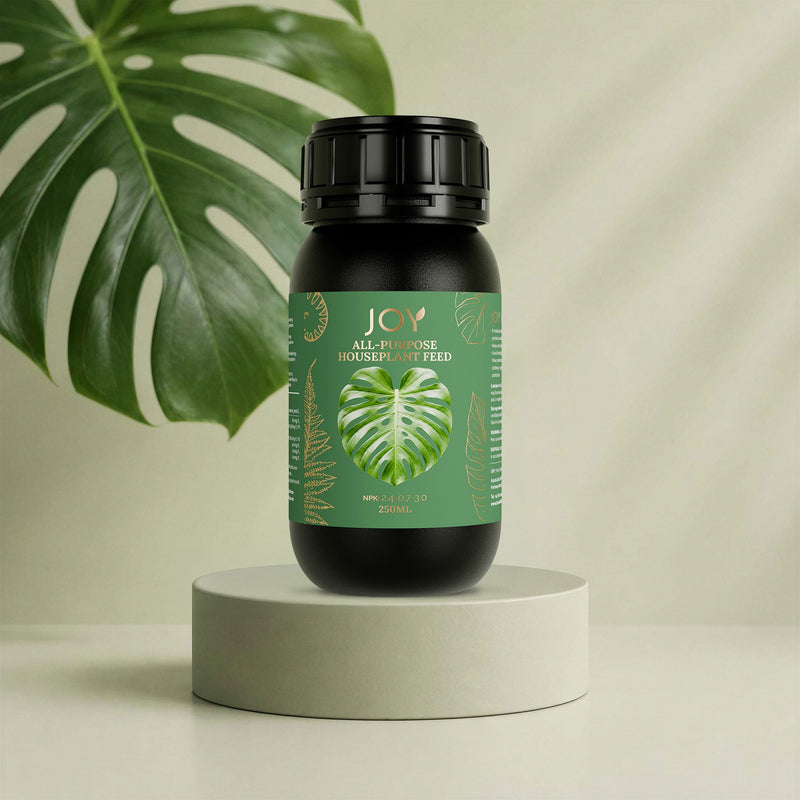
JOY All-Purpose Houseplant Feed Plant Food and Nutrients Grow With Joy
JOY All-Purpose Houseplant Feed — 250ml
JOY All-Purpose Houseplant Feed Plant Food and Nutrients Grow With Joy
JOY

JOY All-Purpose Houseplant Feed

£9.99
Size

Sold out. FREE tracked delivery on orders over £60

Complete the set up
Description

Most all-purpose feeds are a compromise. They are built to keep a huge range of plants fed enough, which usually means your houseplants get more of some elements than they need and not quite enough of the ones that actually build lush, healthy growth. Get the balance wrong and you will see it: pale foliage, leggy growth, or plants that stall just as they are settling in.

Houseplants live for their leaves. That takes consistent nitrogen, the building block of chlorophyll and new growth, alongside potassium, which drives water regulation and overall plant strength. JOY All-Purpose Houseplant Feed is enriched with both at levels tuned for foliage plants, then finished with calcium, magnesium and essential trace elements for strong cell walls, rich green colour and steady growth from root to leaf tip.

As with every JOY product, the formula also carries organic humic and fulvic acids alongside a host of botanical extracts. These make the nutrients more available and more appetising to the plant, so more of what is in the bottle ends up in the leaves. Use it across your whole collection of houseplants, from a slow spider plant to a fast Monstera.

Not sure how much your plant wants? Faster growers with bigger leaves want more frequent feeding, while slower, more delicate plants prefer a lighter touch. The full group-by-group feeding guide, the science behind the formula and the complete guaranteed analysis are below. If you grow under grow lights, keep to the spring and summer rates all year round, and if you want one watering can for everything, 3ml per litre is the single rate that suits most collections.

Formulated by Dr Callie Seaman. Every JOY formula is developed by Dr Callie Seaman, a fertiliser formulation chemist with more than 20 years in plant nutrition. She holds a PhD in plant nutrient science from Sheffield Hallam University, where she remains an Honorary Researcher, and she is a co-founding director of Aqua Laboratories, the science team behind Shogun Fertilisers. This feed deliberately includes the calcium and magnesium most mass market feeds leave out, because a magnesium shortfall shows as yellowing between the leaf veins even when nitrogen is adequate.

Product details

  • Liquid concentrate, NPK 2.4-0.7-3.0
  • Enriched with organic humic and fulvic acids and botanical extracts
  • Pack sizes: 250ml and 1 Litre
  • For all general houseplants and foliage plants
  • Dilution 2 to 5ml per litre depending on plant group, or 3ml per litre as a one can does all rate; full feeding guide below
  • Full guaranteed analysis below
How to use

Shake the bottle well, dilute into room temperature water and feed onto already damp soil, alongside a normal watering. Use plain water between feeds.

  • Hungry houseplants (Monstera, Philodendron, Pothos, Alocasia): 5ml per litre, every 2 weeks in spring and summer
  • Most houseplants (Peace Lily, Spider Plant, ferns): 3ml per litre, every 2 to 3 weeks. Also the one can does all rate for a mixed collection
  • Delicate and slow growing (Calathea, ZZ Plant, Snake Plant): 2ml per litre, every 3 to 4 weeks

Ease off through autumn and pause over winter unless the plant is still visibly growing. The full seasonal guide and guaranteed analysis are further down this page.

Delivery and returns

Every order is hand-packed and sent with tracked delivery.

Changed your mind? You can return unused items within 14 days of delivery. See our returns policy.

Formulated by Dr Callie Seaman
Full guaranteed analysis published below
Hand-packed and sent tracked
Earn 49 points with this order · 5 points per £1 Join free
Dr Callie Seaman

The science behind JOY

Formulated by Dr Callie Seaman

PhD in plant nutrient science, Sheffield Hallam University Honorary Researcher, Sheffield Hallam University Co-founding director, Aqua Laboratories 20+ years formulating plant nutrition

Every JOY formula is developed by Dr Callie Seaman, a fertiliser formulation chemist with more than 20 years in plant nutrition. Her doctoral research focused on the chemistry of hydroponic nutrient solutions, and she is part of the Aqua Laboratories team behind Shogun Fertilisers. The full mineral breakdown of each feed is published below, because a feed you put on your plants should not be a secret.

Which JOY feed is right for your plant?

Start typing a plant name, common or Latin, and we will tell you exactly which feed to use, how much, and how often.

    The science behind JOY Houseplant Feed

    Nitrogen and potassium, in balance

    Houseplants are grown for their leaves, and leaves run on nitrogen. It is the building block of chlorophyll and of every new shoot, and a shortfall shows quickly as pale foliage and slow, leggy growth.

    Potassium is the quiet partner. It drives water regulation and overall plant strength, which is what carries a plant through everyday stresses such as inconsistent light or a missed watering. This feed enriches both in balance, rather than leaning on one at the expense of the other.

    Calcium and magnesium for structure and colour

    UK and EU fertiliser labelling requires NPK content to be stated clearly. Calcium and magnesium are not subject to the same requirement, so most mass market houseplant feeds simply leave them out to keep formulations cheaper.

    That is a real gap. Magnesium sits at the centre of every chlorophyll molecule, and a shortfall shows up as yellowing between the leaf veins even when nitrogen is perfectly adequate. Calcium builds the cell walls responsible for sturdy stems and undistorted new growth, and it is critical to a plant's ability to use several other key elements. JOY includes both as standard, and getting the calcium level right is one of the keys to this formula's performance.

    How often should you feed your plants?

    Not all houseplants are hungry in the same way. Faster growers with bigger leaves want more frequent feeding; slower, more delicate plants prefer a lighter touch. Under grow lights, keep to the spring and summer rates all year.

    Hungry houseplants

    5ml per litre

    Monstera, Philodendron, Pothos, Alocasia, Strelitzia, Ficus, Dieffenbachia, Croton

    Spring / Summer Every 2 weeks
    Autumn Every 3 to 4 weeks
    Winter Stop, or every 6 to 8 weeks

    Most houseplants

    3ml per litre

    Peace Lily, Aglaonema, Spider Plant, Syngonium, Pilea, Ferns, Tradescantia

    Spring / Summer Every 2 to 3 weeks
    Autumn Every 4 weeks
    Winter Stop, or every 6 to 8 weeks

    Delicate and slow growing

    2ml per litre

    Calathea, Maranta, Peperomia, Dracaena, ZZ Plant, Snake Plant

    Spring / Summer Every 3 to 4 weeks
    Autumn Every 4 to 6 weeks
    Winter Stop feeding

    Guaranteed analysis

    The complete mineral breakdown of this feed, exactly as formulated. Concentrations are shown for the neat bottle and at the standard dilution.

    JOY Houseplant Feed guaranteed analysis

    Level at spring and summer dilution of 5ml/L

    ElementConcentrationAt dilution
    Nitrogen (N) total 2.44% 135mg/L
    of which nitrate nitrogen (N) 2.01% 112mg/L
    of which ammoniacal nitrogen (NH4) 0.43% 24mg/L
    Phosphorus pentoxide (P2O5), water soluble 0.65% (0.29% P) 36mg/L (16mg/L P)
    Potassium oxide (K2O) 3.04% (2.55% K) 169mg/L (142mg/L K)
    Calcium oxide (CaO), water soluble 1.26% (0.9% Ca) 70mg/L (50mg/L Ca)
    Magnesium (Mg) 0.36% 20mg/L
    Sulphate (SO4) 0.62% 34mg/L
    Iron (Fe) as EDTA 0.022% 1.24mg/L
    Manganese (Mn) as EDTA 0.008% 0.43mg/L
    Zinc (Zn), water soluble, chelated by EDTA 0.003% 0.17mg/L
    Boron (B), water soluble 0.002% 0.1mg/L
    Copper (Cu) as EDTA 0.001% 0.03mg/L
    Chloride (Cl) 0.23% 13mg/L
    Sodium (Na) Trace Trace
    Botanical extracts 1.60%
    Organic acids (fulvic and humic) 2%

    The science behind every JOY formula

    Most plant food is built to be fed enough for as many plants as possible. An orchid, a Monstera and a Kentia palm do not just look different: they process nutrients differently, at different concentrations and in different ratios, and a single balanced feed cannot serve all three well. JOY is formulated the other way round, by plant type first, which is why there are four distinct feeds rather than one adaptable one.

    Fulvic acid, the fast carrier

    Most fertiliser labels only tell you the NPK. What they leave out is how well the plant can actually use it, and that is where organic acids come in. Fulvic acid is quick acting: it carries nutrients into the plant in a form roots can take up, rather than letting them go to waste in the growing medium.

    Humic acid, the slow builder

    Humic acid works more slowly, improving the growing medium itself over time so nutrients stay available for longer. Every JOY formula carries both acids because they do different jobs, and the pair means better uptake now and a healthier root zone later.

    Botanical extracts for resilience

    A blend of botanical extracts adds a third layer of support, helping the plant cope with everyday stress such as a missed watering, a repot or a change in light. The result is a plant that handles the ordinary ups and downs a little more easily.

    You may also like

    More like this

    Good to know

    Frequently Asked Questions

    Can I use this on all my houseplants?

    Yes. It is formulated as a general foliage feed for the vast majority of common houseplants. It works best at the dilution for your plant group, or use 3ml per litre as a single one can does all rate.

    Will this help with pale or slow growing leaves?

    Pale, slow growth is often a sign of too little nitrogen and magnesium. This feed is enriched in both to support strong, healthy green growth.

    Do I need a different feed for flowering houseplants?

    For plants grown mainly for foliage this is the one, and it works well for most flowering houseplants too. For orchids, use JOY Premium Orchid Feed instead.

    How often should I feed my houseplants?

    Every 2 to 4 weeks through spring, summer and early autumn, alongside a normal watering and always onto already damp soil, never bone dry. Hungry growers such as Monstera and Pothos take a feed every 2 weeks, most houseplants every 2 to 3 weeks, and delicate, slower growers every 3 to 4 weeks. JOY is not designed to go in with every watering, so use plain water in between.

    Should I feed my houseplants in winter?

    Most houseplants slow right down over a UK winter, so pause feeding or drop to every 6 to 8 weeks at most from roughly November to February. Plants kept warm, bright or under grow lights for eight or more hours a day can keep close to their normal routine, because it is the light a plant receives that decides how much feed it can use. In spring, ease back in with a single reduced strength feed as new growth appears.

    How do I tell underfeeding from overfeeding?

    Underfeeding is slow and even: pale, washed out colour across the whole plant and smaller new leaves, developing over weeks. Overfeeding is faster and more specific: crisp, browning leaf edges or tips, often with a white, crusty mineral residue on the soil that underfeeding never produces, and sometimes wilting despite moist soil. If you are genuinely unsure, assume underfeeding; it is the easier one to correct.

    What is fertiliser burn and how do I avoid it?

    Fertiliser burn is a build up of mineral salts from feeding too often or too strong, which draws moisture out of the roots and shows as crisp, browning leaf edges with a crusty residue on the soil. Stick to the recommended dilution rather than rounding up for faster growth. If it happens, flush the pot with several times its volume of plain water, pause feeding for a few weeks, then resume at a reduced strength. Young, small potted and recently repotted plants are the most vulnerable.

    Why does this feed include calcium and magnesium when most do not?

    UK and EU labelling rules require NPK to be declared but not calcium or magnesium, so many feeds leave them out to keep formulations cheaper. Magnesium sits at the centre of the chlorophyll molecule, and a shortfall shows as yellowing between the leaf veins even when nitrogen is fine. A calcium shortfall shows structurally, as distorted or crinkled new leaves and weak stems. Both are included here as standard.

    How do I feed a Monstera for bigger leaves?

    Feed every 2 weeks at full strength, or weekly at half strength, through the growing season; consistency over the season beats intensity in any one feed. Pair it with bright, indirect light and something to climb, since a supported Monstera produces larger leaves than a sprawling one. Feeding drives leaf size and how fast new leaves appear, but fenestrations come mainly with maturity and light, so a young plant will not split regardless of feed.

    Do Calathea and other delicate plants need a different approach?

    Yes, a gentler one. Calathea, Maranta and Peperomia are more sensitive to mineral salts and show crispy leaf edges if fed too strongly, so use roughly half the standard dilution for them while Philodendron, Alocasia, Pothos and Syngonium take the full rate. Crispy edges on a Calathea while the rest of the shelf looks fine is the classic sign its feed is too strong.

    My plant has stopped growing. Is feed the answer?

    Check light first, since it is the more common cause and feeding cannot compensate for it, then root health and watering consistency. Most tropical foliage also stalls below about 15 degrees, and slower growth through a UK winter is normal. Once those look right, an unfed or inconsistently fed plant will respond to a steady routine. Make one change at a time and give it three to four weeks before judging.

    When should I start feeding a new or repotted houseplant?

    Wait four to six weeks after a new plant arrives, and two to four weeks after repotting, because fresh potting mix already carries nutrients and disturbed roots are vulnerable to burn. Start again with a dilute feed once you see new growth, and build back to the normal routine over the following month. JOY Propagation Feed is formulated for exactly this settling in stage.

    What is your returns policy?

    Changed your mind? You can return pots, gifts, accessories and other non-plant items. Email hello@growtropicals.com with your order number within 14 days of delivery, then send the item back within 14 days of telling us. You pay the return postage.

    Items must come back unused and in their original condition. If an item has been used, we may reduce your refund by the value it has lost, and for used items this can be the full price.

    Live plants cannot be returned because you have changed your mind, but they are covered by our Live Arrival Guarantee.

    If something arrives damaged, faulty or wrong, email us with your order number and photos and we will put it right at no cost to you. Full details are in our returns policy.

    When will my order arrive and how much is shipping?

    Choose your delivery speed at checkout. Express orders placed before 1pm are dispatched the same day, otherwise the next working day. Standard orders are dispatched within 2 to 3 working days and Economy orders within 4 to 5 working days. Once dispatched, every order travels by 24 hour tracked courier.

    Delivery is free on orders over £60 with Economy, over £100 with Standard and over £150 with Express. Below that, the charge depends on your basket total and is always shown at checkout before you pay. The full price list is in our shipping policy.

    Orders without plants are dispatched Monday to Friday. If your order also includes plants, it goes out Monday to Thursday so the plants are not left in the courier network over the weekend. Delivery can take longer at busy times such as Black Friday and Christmas.

    View all FAQs

    Why Grow Tropicals

    Packed with care and ready to give

    Packed with care

    Packed with care

    Every order is hand-packed in protective packaging and sent with tracked delivery, so it reaches you in one piece.

    Free tracked delivery on orders over £60.

    Ready to give

    Ready to give

    Add a gift message at checkout and we will handwrite it and pack it with your order.

    Pair it with a plant for a complete gift.

    Easy returns

    Easy returns

    Changed your mind? Send unused items back within 14 days of delivery and we will refund you.

    Full details in our returns policy.

    Verified reviews

    Rated by real customers

    JOY All-Purpose Houseplant Feed
    £9.99