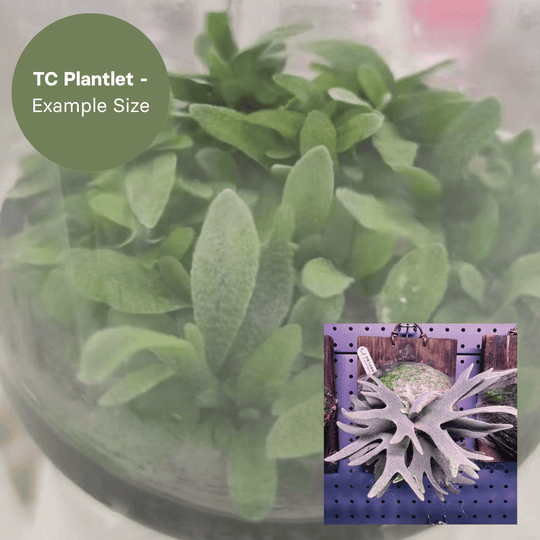
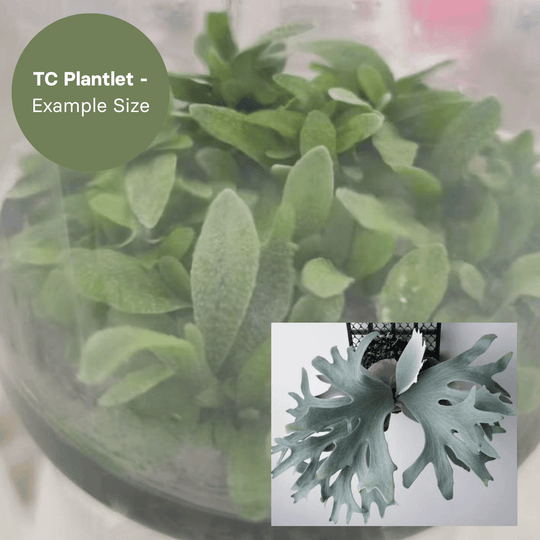
Staghorn Fern
Platycerium Care Guide

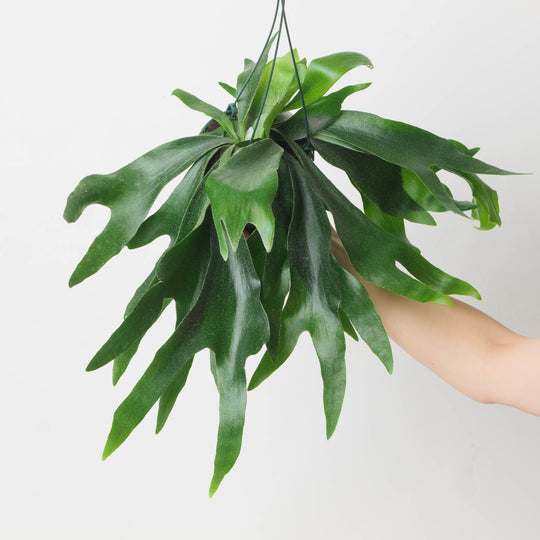
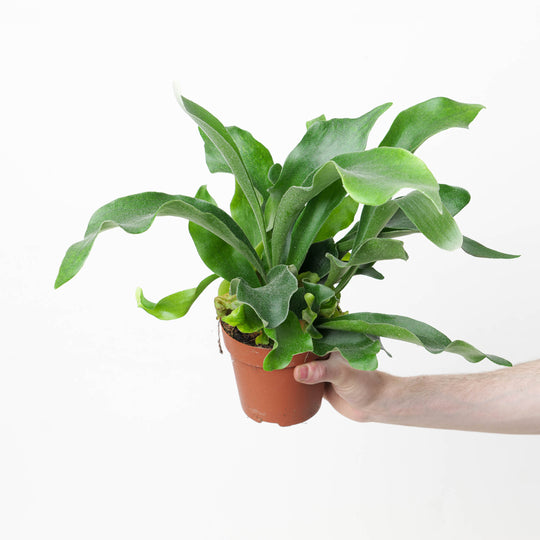
If you have ever walked past a plant that looks like a set of antlers mounted on a wall and wondered what on earth it was, you have almost certainly met a staghorn fern. Its proper name is Platycerium, and it is one of the most unusual houseplants you can grow.
The single most important thing to understand about a staghorn fern is this: in the wild, it does not grow in soil at all. It grows attached to the trunks and branches of trees. Once you know that, everything else about its care starts to make sense. Give it good drainage, moving air, and the right amount of light, and you will find it is far easier to keep alive than its dramatic, sculptural appearance suggests.
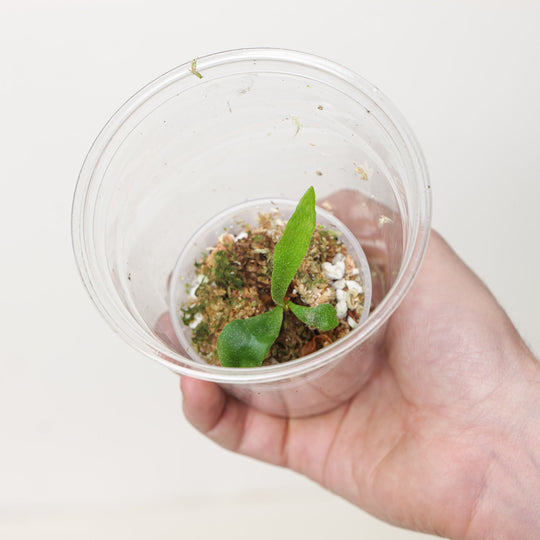
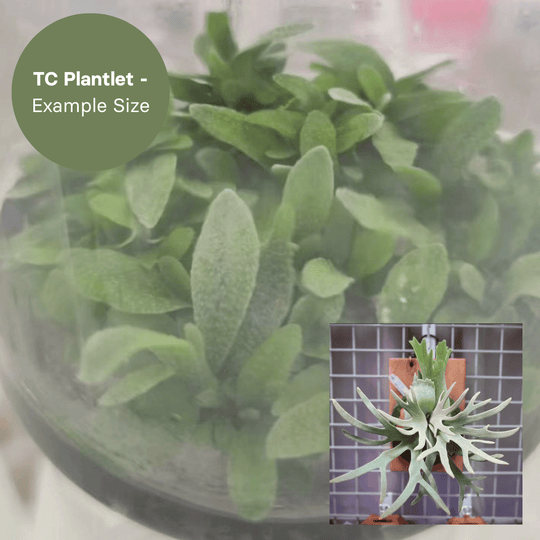
This guide walks you through light, watering, mounting, feeding, and the varieties that do best in a British home. At our nursery we grow several Platycerium species alongside tissue-culture clones, so everything here is based on what works in UK houses rather than what happens in a tropical rainforest.
Where Staghorn Ferns Come From
Staghorn ferns are ancient plants. Ferns as a group have been around for roughly 360 million years, which means they were growing long before the first flowering plants appeared, and long before dinosaurs walked about underneath them. Like all ferns, Platycerium does not produce flowers or seeds. Instead it reproduces using spores, which form in fuzzy brown patches on the undersides of the mature fronds.
The name Platycerium comes from two Greek words: platys, meaning broad or flat, and keras, meaning horn. The botanist Nicaise Desvaux gave the genus its name in 1827, and it is an accurate description. The common names follow the same idea, because people have been calling these plants staghorn ferns and elkhorn ferns for generations.
There are around 18 recognised species, and they are spread across the warm parts of the world. Most come from Southeast Asia, tropical Africa, Madagascar, New Guinea and eastern Australia. Only one species, Platycerium andinum, grows naturally in the Americas, where it is found in the forests of Peru and Bolivia. In every case, these plants live as epiphytes, which simply means they perch on trees rather than rooting in the ground. It is worth saying clearly that they are not parasites. They take nothing from the tree itself. The tree is just a place to sit, closer to the light and the moving air.
The Two Kinds of Fronds
Staghorn ferns grow two completely different types of leaf, and knowing which is which will save you a lot of worry later on.
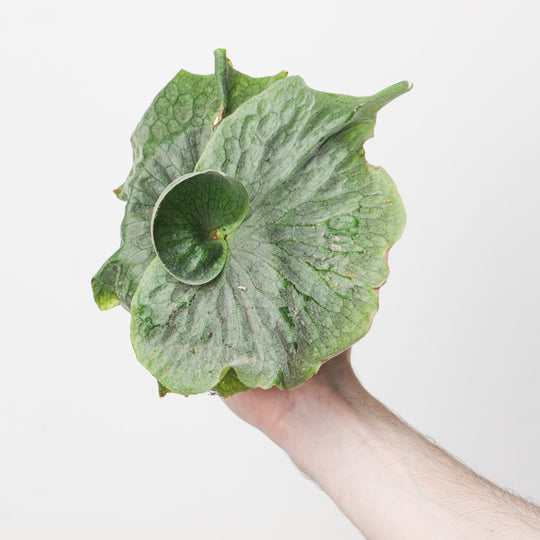
The first type is the shield frond, sometimes called the basal frond. This is the flat, round, papery leaf that presses itself against the mount or the tree trunk. Its job is to anchor the plant and to act as a natural compost bin. In the wild, falling leaves and debris get caught behind the shield frond, where they rot down and feed the plant. Shield fronds are meant to turn brown and dry as they age. That is completely normal and is not a sign that anything has gone wrong.
The second type is the antler frond, which is the forked, branching leaf that gives the plant its name. These are the fertile fronds, and they are where the spores eventually form.
British plant lovers have been captivated by ferns for a very long time. During the Victorian era there was a genuine craze for them, so widespread that it earned its own name, pteridomania, or fern fever. Staghorns were among the most prized of all, precisely because they looked so unlike anything else.
How Much Light Does a Staghorn Fern Need?
Staghorn ferns want bright but indirect light. The easiest way to picture this is to imagine where the plant would sit in a forest: up in the canopy, catching plenty of brightness, but always with leaves filtering the harshest sun above it.
In practice, an east-facing window is ideal. A north-facing window works well through the summer months. If you only have a south or west-facing window, place the plant one to two metres back from the glass rather than directly in front of it. Platycerium bifurcatum and Platycerium alcicorne are the most forgiving and will cope with a wider range of conditions than most. Platycerium grande and the larger cultivars are hungrier for light, so they can sit closer to the window.
You can tell when a plant is getting too much light because pale, bleached patches appear on the fronds, and the tips may go crispy during summer. If you see this, move the plant back by 30 to 50 centimetres and it will usually recover on its own.
Too little light produces the opposite set of clues. New fronds appear slowly, the growth looks thin and droopy, and the shield frond stays small and pale green instead of maturing to a coppery brown. If your room is naturally dim, a grow light positioned 40 to 50 centimetres above the plant will fix the problem quickly.
How Often Should You Water a Staghorn Fern?
Rather than watering on a fixed schedule, it is better to learn what a thirsty staghorn feels like. Lift the plant, or press a finger against the mount. When the root mass feels noticeably light and the shield frond feels dry to the touch, it is time to water. For most UK homes this works out at roughly once a week during summer and once every 10 to 14 days during winter.
The best way to water a mounted staghorn is to soak it rather than pour water over the top. Take the plant down from the wall, submerge the root ball in a bucket of tepid water, and leave it there for 10 to 15 minutes. Lift it out, let it drain for a few minutes so it is not dripping, and then hang it back up. This properly rehydrates the sphagnum moss or coco coir that the roots are growing into, without leaving anything soggy.
Potted staghorns can be watered from the top instead, but you must let the excess drain away completely. A staghorn sitting in permanently wet substrate is the single fastest way to kill one.
Overwatering announces itself fairly clearly. You will see blackening at the base of the shield frond, the antler fronds will feel soft or mushy, and the mount may give off a sour smell. If you notice any of these, cut back on watering straight away and improve the airflow around the plant.
Underwatering is much easier to fix. The antler fronds curl inwards and feel dry and papery, almost like parchment. A single good soak usually brings the plant back within 24 hours.
Soil, Substrate and Mounting Options
Because staghorns evolved to grow on trees, they need air circulating around their roots rather than dense, heavy compost packed against them. There are three approaches that work well indoors, and all of them are perfectly valid.
The first option is mounting the plant on a board, which is the traditional method and the one that shows the plant off best. You use long-fibre sphagnum moss or coco coir fibre as the growing medium, then tie the whole thing onto a piece of hardwood or cork bark using fishing line or cotton twine.
The second option is to pot the plant into a coarse, chunky epiphytic mix. A good recipe is roughly equal parts medium-grade orchid bark, coarse perlite and horticultural charcoal, with a small handful of sphagnum moss stirred through to hold a little moisture. Please avoid ordinary houseplant compost, because it holds far too much water for this kind of plant.
The third option is a hanging basket lined with moss, which is a sensible compromise for larger specimens and works particularly well for Platycerium grande.
Repotting and Remounting
Staghorn ferns genuinely dislike being disturbed, so the best advice is to leave yours alone as much as possible. You only need to repot or remount when the shield fronds have grown right over and around the existing mount, which typically happens every three to five years.
When the time comes, move the plant up to a slightly larger mount or basket and handle the root ball as gently as you can, disturbing it as little as possible. Late spring is the best moment to do this, because the plant is just entering its active growing season and will recover more quickly.
Staghorns also produce baby plants, known as pups, which grow out from the mother plant. You can separate a pup with a clean, sharp knife once it is at least 10 centimetres across and has started forming its own shield frond. Mount it on fresh moss and keep the humidity high for the first month while it settles in and establishes roots.
Feeding Your Staghorn Fern
Staghorns are slow, steady feeders, and they do not need much. A weak, balanced liquid feed once a month through spring and summer is plenty. We use Liquid Gold Leaf diluted to half the usual strength, which works very well.
There is also an old grower's trick that sounds odd but genuinely works. Every few months, tuck a banana skin behind the shield frond. As it breaks down it releases potassium slowly, which is exactly how the plant feeds itself in the wild using trapped leaf litter. It is a little messy, but the plants clearly appreciate it.
One important rule: never feed a staghorn that is stressed or has only recently been mounted. Wait until you see fresh antler fronds appearing before you start any feeding routine.
Common Problems and How to Fix Them
The shield frond is turning brown
This is not a problem at all, and it catches out almost every new staghorn owner. The shield frond is supposed to turn brown and papery as it matures. Once it does, it becomes part of the structure of the plant and slowly breaks down to feed the roots behind it. Leave it exactly where it is. The only time to remove a shield frond is when it has gone soft, black and smells rotten, and that is a sign of overwatering rather than old age.
The antler frond tips are going crispy
This is almost always low humidity combined with hot, dry air. It is extremely common in UK homes between October and March when the central heating is running. You can help by grouping plants together so they share moisture, by running a humidifier, or by moving the plant to a naturally damper room such as a bathroom with a window.
We deliberately do not recommend misting. It only raises the humidity around the plant for a few minutes, and the water sitting on the fronds can encourage fungal problems.
There are small brown bumps on the fronds
These are scale insects, and they are by far the most common pest on staghorn ferns. You will usually spot them as small brown or tan bumps sitting along the frond midribs. For a light infestation, simply remove them by hand using a cotton bud dipped in horticultural soap. If the problem is more widespread, our scale insect guide will walk you through a full treatment.
There are black spots at the base of the plant
This is bacterial or fungal rot, and it is caused by too much water. Move the plant somewhere with better airflow, allow it to dry out completely, and cut away any mushy tissue with a sterile blade. Prevention is far easier than cure here, and it comes down to three things: good airflow, good drainage, and a bit of restraint with the watering can.
Still Not Sure?
If something is happening with your staghorn and you cannot work out what, please do send us a photo. We are always happy to take a look and help you figure it out.