


Packed with care
Every order is hand-packed in protective packaging and sent with tracked delivery, so it reaches you in one piece.
Free tracked delivery on orders over £60.




Black Friday deal You save
Baby plants need baby food. Cuttings and seedlings are delicate things, and during propagation a plant can only tolerate feed up to a certain total strength. Go too strong and the whole propagation can fail.
Some growers solve this by diluting a normal fertiliser to half or quarter strength. That brings the overall strength down to a level young plants can tolerate, but it also dilutes every element in the mix, including the micronutrients a developing plant needs most at this critical stage.
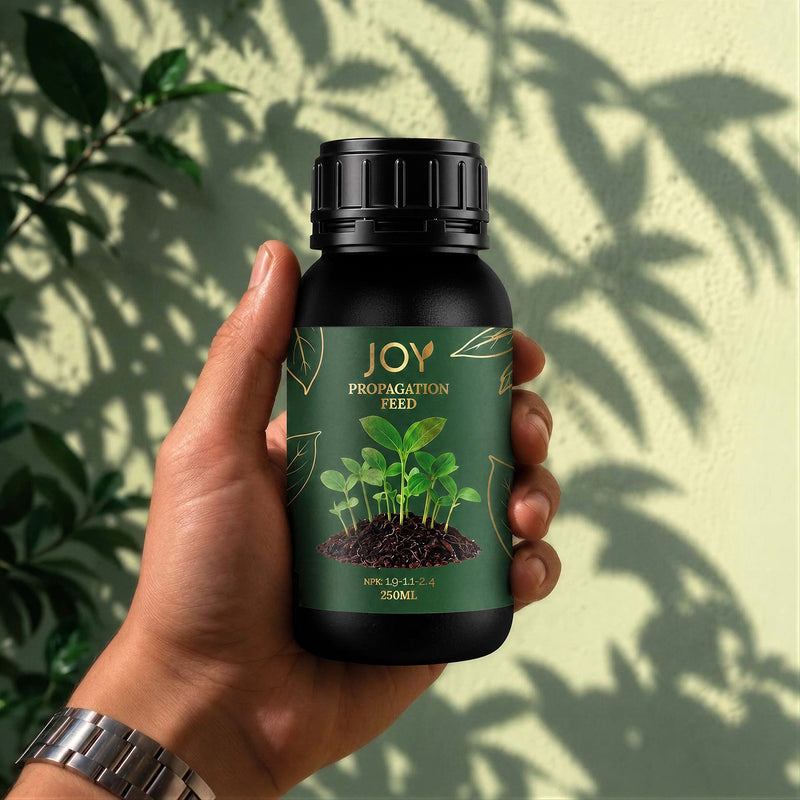
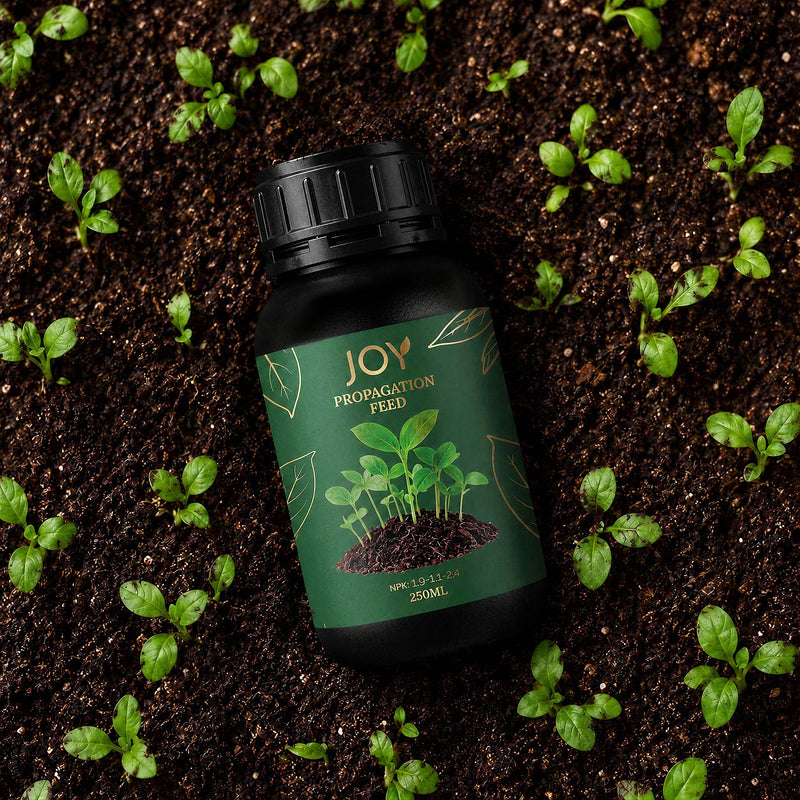
JOY Propagation Feed takes a different approach. It maintains optimum levels of all micronutrients while specifically reducing nitrogen, phosphorus and potassium, the elements that make up most of a fertiliser's overall strength. The result is a feed at the right total strength with nothing missing: not just diluted, but specifically formulated for propagation. The full stage-by-stage guide, the formulation science and the complete guaranteed analysis are below.
Once a plant shows at least two sets of leaves and clear root growth, move it on to JOY All-Purpose Houseplant Feed or one of the plant specific JOY feeds.
Formulated by Dr Callie Seaman. Every JOY formula is developed by Dr Callie Seaman, a fertiliser formulation chemist with more than 20 years in plant nutrition. She holds a PhD in plant nutrient science from Sheffield Hallam University, where she remains an Honorary Researcher, and she is a co-founding director of Aqua Laboratories, the science team behind Shogun Fertilisers. Rather than dilute a standard feed, she formulated this one from scratch at propagation strength, keeping every micronutrient at its optimum level.
Product details
Every order is hand-packed and sent with tracked delivery.
Changed your mind? You can return unused items within 14 days of delivery. See our returns policy.


The science behind JOY
Every JOY formula is developed by Dr Callie Seaman, a fertiliser formulation chemist with more than 20 years in plant nutrition. Her doctoral research focused on the chemistry of hydroponic nutrient solutions, and she is part of the Aqua Laboratories team behind Shogun Fertilisers. The full mineral breakdown of each feed is published below, because a feed you put on your plants should not be a secret.
Start typing a plant name, common or Latin, and we will tell you exactly which feed to use, how much, and how often.
Cuttings and young plants can only tolerate feed up to a certain total strength. The common workaround, diluting a normal feed to half or quarter strength, brings the overall strength down, but it dilutes every nutrient equally, including the micronutrients a developing plant needs most. This feed is formulated at propagation strength instead, so it is safe at full strength with nothing missing.
| Normal feed, diluted | JOY Propagation Feed | |
|---|---|---|
| Overall strength | Reduced to a safe level | Formulated to a safe level |
| Micronutrients | Diluted along with everything else | Maintained at optimum |
| N-P-K | Diluted along with everything else | Specifically reduced |
Different elements in a fertiliser interact: some help a plant take up what it needs, others hinder it. This feed uses a specific calcium to boron ratio that helps direct auxins, the plant hormones responsible for leaf tip and root tip growth, to exactly where they are needed, at the stage when it matters most.
Phosphorus is best known as a flowering element, but it is just as important for root and root hair formation in young plants. Stronger roots mean a cutting is ready to pot on sooner. This feed carries the right amount to support that without overloading the total feed strength.
Propagation feeding is about stage, not plant type. Follow your cutting or seedling through these three phases, all at 4ml per litre.
Pre-soaking the rooting media
| Frequency | Once, before planting |
|---|---|
| Purpose | Primes the media |
| Watch for | Damp, not waterlogged |
Weeks 1 to 2
| Frequency | Every few days |
|---|---|
| Watch for | Slight dry back between feeds |
Once roots form
| Frequency | Continue every few days |
|---|---|
| Next step | Move to JOY All-Purpose Houseplant Feed |
The complete mineral breakdown of this feed, exactly as formulated. Concentrations are shown for the neat bottle and at the standard dilution.
Level at recommended dilution of 4ml/L
| Element | Concentration | At dilution |
|---|---|---|
| Nitrogen (N) total | 1.90% | 80mg/L |
| of which nitrate nitrogen (N) | 1.80% | 75mg/L |
| of which ammoniacal nitrogen (NH4) | 0.1% | 5mg/L |
| Phosphorus pentoxide (P2O5), water soluble | 1.1% (0.5% P) | 46mg/L (20mg/L P) |
| Potassium oxide (K2O) | 2.4% (2.0% K) | 92mg/L (76mg/L K) |
| Calcium oxide (CaO), water soluble | 1.9% (1.3% Ca) | 84mg/L (60mg/L Ca) |
| Magnesium (Mg) | 0.6% | 26mg/L |
| Sulphate (SO4) | 1.60% | 70.11mg/L |
| Iron (Fe) as EDTA | 0.079% | 3.5mg/L |
| Manganese (Mn) as EDTA | 0.036% | 1.6mg/L |
| Zinc (Zn), water soluble, chelated by EDTA | 0.02% | 1mg/L |
| Boron (B), water soluble | 0.02% | 1mg/L |
| Copper (Cu) as EDTA | 0.003% | 0.13mg/L |
| Chloride (Cl) | Trace | under 5mg/L |
| Sodium (Na) | Trace | under 5mg/L |
| Botanical extracts | 1.60% | |
| Organic acids (fulvic and humic) | 5% |
Most plant food is built to be fed enough for as many plants as possible. An orchid, a Monstera and a Kentia palm do not just look different: they process nutrients differently, at different concentrations and in different ratios, and a single balanced feed cannot serve all three well. JOY is formulated the other way round, by plant type first, which is why there are four distinct feeds rather than one adaptable one.
Most fertiliser labels only tell you the NPK. What they leave out is how well the plant can actually use it, and that is where organic acids come in. Fulvic acid is quick acting: it carries nutrients into the plant in a form roots can take up, rather than letting them go to waste in the growing medium.
Humic acid works more slowly, improving the growing medium itself over time so nutrients stay available for longer. Every JOY formula carries both acids because they do different jobs, and the pair means better uptake now and a healthier root zone later.
A blend of botanical extracts adds a third layer of support, helping the plant cope with everyday stress such as a missed watering, a repot or a change in light. The result is a plant that handles the ordinary ups and downs a little more easily.
We could not find a close match for that. Ask us directly and a real plant person will reply.
Contact usEvery order is hand-packed in protective packaging and sent with tracked delivery, so it reaches you in one piece.
Free tracked delivery on orders over £60.

Add a gift message at checkout and we will handwrite it and pack it with your order.
Pair it with a plant for a complete gift.

Changed your mind? Send unused items back within 14 days of delivery and we will refund you.
Full details in our returns policy.

Log in or create an account to use your points.