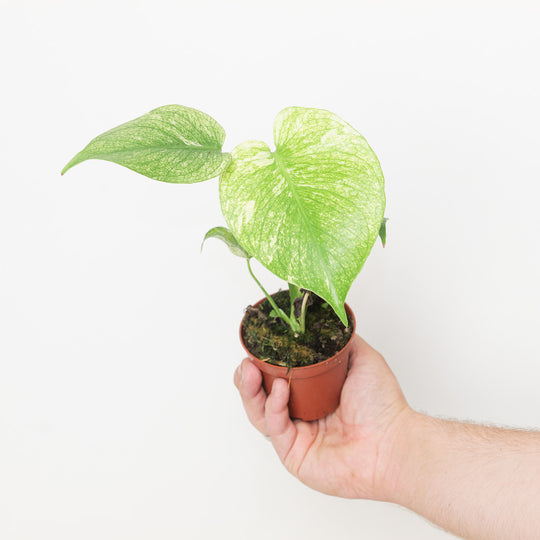
Strawberry Begonia
Saxifraga Care Guide

Saxifraga stolonifera, better known as Strawberry Begonia, is a charming trailing houseplant with an unusual story behind its name. Despite the common name, it is neither a strawberry nor a begonia. It belongs to the Saxifragaceae family and is native to parts of East Asia, including China, Japan and Korea, where it grows naturally in cool, damp woodland environments.
Its strawberry-like reputation comes from the delicate red stolons it produces, sending out strings of tiny plantlets that trail away from the mother plant much like runners on a strawberry plant. Its rounded, silver-veined leaves and graceful habit have made it a long-standing favourite for hanging baskets, shelves and plant collections.
In this guide, we look at where Saxifraga stolonifera comes from, what makes it distinctive, the varieties worth knowing and the key things to understand about growing this unusual little plant indoors.
Light Requirements for Saxifraga
Bright, indirect light is best for Saxifraga. Near an east-facing window, or a metre or two back from a brighter south or west aspect, suits it well. Saxifraga stolonifera also tolerates lower light better than most variegated plants, which is why it works in spots where fussier houseplants sulk.
Too much light can bleaches the leaves and crisps the edges. Too little slows growth, the runners get sparse, and variegated forms lose their pink and cream tones. If you only have a dim corner, the plain green species copes better than the variegated cultivars. Browse our low light houseplants if light is your main constraint.
How Often to Water Strawberry Begonia
Water when the top 2 to 3cm of compost feels dry, then water thoroughly and let the excess drain away. In practice that tends to mean every 7 to 10 days in summer and considerably less in winter, perhaps every two to three weeks.
Strawberry begonia has fine, shallow roots that rot quickly in soggy compost. It would rather dry out slightly than sit wet. Signs of overwatering include yellowing lower leaves, a soft mushy crown, and a sour smell from the soil. Signs of underwatering include limp, drooping leaves that perk up within hours of a drink. If you ever tip it into overwatering, our guide on saving a plant with root rot walks through the recovery.
Best Soil and Potting Mix for Saxifraga
Use a free-draining, peat-free mix. A standard houseplant compost lightened with a couple of handfuls of perlite or fine bark works well, since the goal is compost that holds moisture briefly, then drains. Avoid dense, water-retentive potting soil that stays wet for days. We use blends from our own premium substrate range, which are formulated for the drainage most of our plants need.
Repotting Saxifraga
Repot every couple of years, or when roots start creeping out of the drainage holes. Strawberry begonia has a compact, clumping root system and runs more freely when slightly snug, so go up just one pot size rather than overpotting into a big container. Spring is the best time, ahead of the main growing season. Always use a pot with drainage holes.
Propagating Saxifraga
This is where strawberry begonia earns its keep. It propagates itself. Each stolon carries a small plantlet at the tip, already forming roots.
- Leave a plantlet attached to the parent and rest it on a small pot of moist compost next to the main plant.
- Pin it down with a bent paperclip or a small stone so the base sits in contact with the soil.
- Keep the compost lightly moist. Roots take hold within two to three weeks.
- Once the plantlet is anchored and growing, snip the runner connecting it to the parent.
You can also cut a well-rooted plantlet straight off and pot it up on its own, though the pinning method has a higher success rate. Variegated plants pass their colouring on to the plantlets, so a pink and cream parent gives you pink and cream babies.
Common Problems when growing Saxifraga
Crispy leaf edges
Usually signals too much direct sun, or compost drying out too far between waterings. Move it back from the glass and check your watering rhythm.
Yellow lower leaves
Is often due to overwatering. Let the compost dry further and confirm the pot drains.
Loss of variegation
Is caused by not enough light. Variegated forms need brighter conditions than the plain species to hold their colour.
Pests
Vine weevil and aphids are the ones to watch. Vine weevil grubs attack the roots of Saxifraga in particular, so if a plant collapses suddenly with no obvious cause, check the rootball. It is a forgiving plant otherwise, and a good choice if you want something that spreads and propagates itself with almost no intervention. If you are just starting out, it sits comfortably alongside the picks in our easy care houseplants collection.