Jewel Orchid
Anoectochilus Care Guide

Most orchids are grown for their flowers. Anoectochilus is the exception, and that is exactly why people fall for it. These are terrestrial jewel orchids, and they are prized almost entirely for their foliage. The leaves are deep, velvety and dark, laced with fine metallic veins that catch the light like gold embroidery stitched into fabric. When a shaft of light hits one at the right angle, it genuinely looks as though the leaf is lit from within.
Jewel orchids are humidity-loving, low-light plants that must never dry out completely, and they will scorch if you put them in direct sun. Almost everything else follows from those three points.
Below we cover light, watering, humidity, potting mix, repotting, propagation, the varieties worth seeking out, and the problems we see most often. Most of our Anoectochilus come through our own tissue-culture lab, so this advice reflects how we actually grow and acclimatise them at the nursery.
Where Jewel Orchids Come From
Orchids belong to one of the largest plant families on earth, with somewhere around 28,000 recognised species. Anoectochilus is a small corner of that enormous family, containing roughly 40 species, and it occupies a very particular niche.
Unlike the epiphytic orchids most people picture, which perch on tree branches, Anoectochilus species are terrestrial. They creep along the shaded forest floor, rooting into damp leaf litter beneath a dense canopy. Their natural range runs from the Himalayas and southern China through Southeast Asia and Indonesia, reaching as far as northern Australia and some Pacific islands. That habitat explains everything about their care: constant humidity, gentle warmth, deep shade, and a substrate that stays evenly damp without ever flooding.
The name itself comes from Greek. Anoiktos means open and cheilos means lip, a reference to the shape of the flower's lower petal. The botanist Carl Ludwig Blume described the genus in 1825 while working in Java.
There is a lovely piece of science behind the shimmer, too. The metallic sheen is not pigment. It comes from the structure of the leaf surface itself, where specialised cells bend and scatter light. Researchers believe this may help the plant squeeze more value out of the very dim light that reaches a forest floor, which is a neat solution to a real problem.
A quick note on the flowers: jewel orchids do bloom, producing modest spikes of small white or cream flowers. Many growers snip the spike off as soon as it appears, because flowering takes a surprising amount of energy from a plant this small and can leave the foliage looking tired afterwards. Since the leaves are the reason you bought it, that is a perfectly reasonable trade.
How Much Light Does a Jewel Orchid Need?
Jewel orchids want low to medium indirect light, and they genuinely mean it. These plants evolved under a thick canopy, so they are adapted to far less light than almost any other houseplant you own. An east-facing windowsill works beautifully. So does a spot two to three metres back from a brighter window.
You will know a plant is getting too much light because the velvet dulls and loses its depth. The leaves shift towards a washed-out olive or a reddish-bronze, and the surface can look faintly bleached. The fix is simply to move the plant further back from the window.
Too little light shows up differently. The stems stretch, the gaps between the leaves widen, and growth slows to a crawl. Jewel orchids will tolerate real shade, but they still need enough light to hold their colour properly. If your home is dark, a modest LED grow light running for 10 to 12 hours a day does the job nicely. That is exactly how we keep ours looking their best through a British winter.
How Often Should You Water Anoectochilus?
The aim is to keep the substrate lightly and evenly moist at all times: never soaking, never bone dry. Jewel orchids do not have the thick water-storing roots or pseudobulbs that many orchids rely on. Their roots are fine, shallow and close to the surface, and they resent both extremes equally.
In practice, water when the top one to two centimetres of the mix feels barely damp. That usually works out at every four to seven days in summer, and rather less often through winter. Always use room-temperature water, because cold water can shock the roots.
If you can, use rainwater or filtered water rather than hard tap water. The minerals in hard water leave chalky marks on the velvet and can gradually cause browning at the leaf tips. It makes a visible difference over a year or two.
Overwatering shows itself as yellowing lower leaves, a stem base that feels soft or looks blackened, and a sour smell coming from the pot. Stem rot spreads quickly in jewel orchids, so if you are genuinely unsure, always err slightly on the drier side.
Underwatering is gentler but still worth avoiding. The leaves lose their firmness and the edges go crisp. A jewel orchid that dries out completely will often start dropping leaves from the bottom of the stem upwards. If that happens, water it thoroughly, raise the humidity around it, and give it time to recover.
Humidity Is the Make-or-Break Factor
This is the part that catches most people out. Anoectochilus wants humidity somewhere between 60 and 80 per cent, which is considerably higher than the average British home, particularly once the heating comes on in autumn.
We do not recommend misting as a solution. It raises the humidity for only a few minutes, and it leaves water sitting on the velvety leaf surface, which is an open invitation to fungal spotting.
The good news is that jewel orchids stay small, which makes them ideal candidates for an enclosed environment. A terrarium, a glass cloche or a converted display cabinet will hold the moisture they want without ever wetting the foliage. If you are building a larger collection, a grow cabinet or tent with a small fan for gentle air movement works very well.
If you would rather keep yours out on an open shelf, group it together with other plants so they share moisture, and stand the pot on a pebble tray to lift the humidity in its immediate surroundings. It is not as effective as an enclosure, but it helps.
Soil and Potting Mix
Because jewel orchids are terrestrial rather than epiphytic, the standard chunky bark orchid mix is wrong for them. It is far too coarse and dries out much too quickly. What they want instead is a fine, moisture-retentive medium that still allows air to reach the roots.
At the nursery, we pot ours into a fine terrarium-style blend of sphagnum moss, fine bark, perlite and a little charcoal. Our Simply Terrarium mix is very close to what we use in the lab and works perfectly well straight from the bag.
If you would rather mix your own, aim for something that holds moisture steadily without ever becoming waterlogged. Whichever route you take, make absolutely sure the pot has drainage holes.
Repotting
Plan to repot every one to two years, or whenever the creeping stem has clearly outgrown its pot. Spring is the ideal time, since the plant is about to move into active growth.
Because jewel orchids are shallow-rooted, choose a wide, shallow pot rather than a deep one, and only move up a single size at a time. Handle the stems carefully as you work, because they snap easily and the velvet bruises where you press it. Once the plant is repotted, keep the humidity high and hold off on strong light for about a week while the roots settle in.
How to Propagate Jewel Orchids
Jewel orchids are among the easiest orchids to propagate at home, which surprises a lot of people. The reason is that they grow from a creeping rhizome rather than from a single central crown, so there are plenty of points along the stem that can produce new roots.
Stem cuttings are the simplest method. Cut a healthy section of stem that includes two or three nodes, then lay it flat on damp sphagnum moss or a fine potting mix. Keep it warm and humid, and roots will begin forming at the nodes within a few weeks.
Division works well once a plant has developed several growing points. Lift the whole plant out of its pot, gently separate the rhizome into clumps, and make sure each clump has both roots and a growing tip. Pot each one up individually.
In both cases, warmth and humidity do most of the work for you. A propagation box or a simple covered tray will keep conditions stable enough for reliable results.
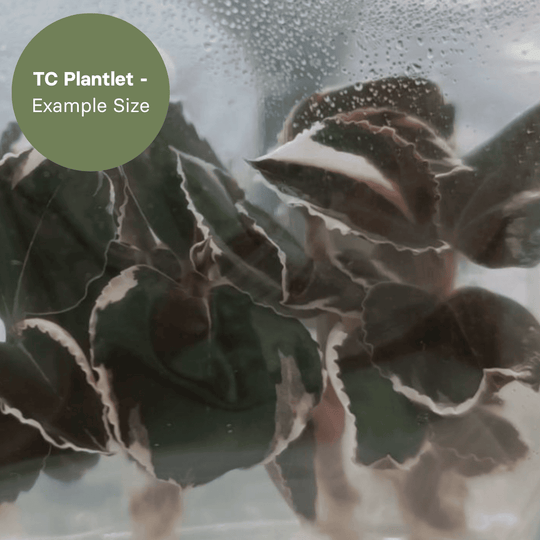
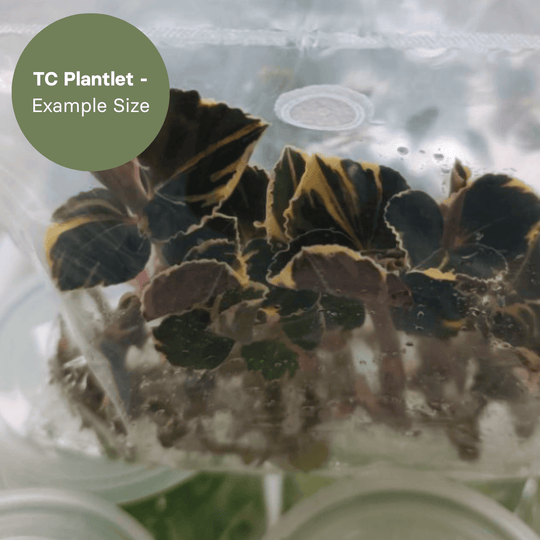
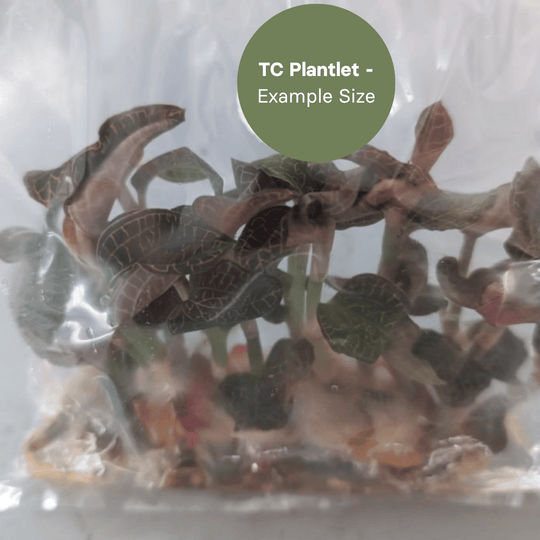
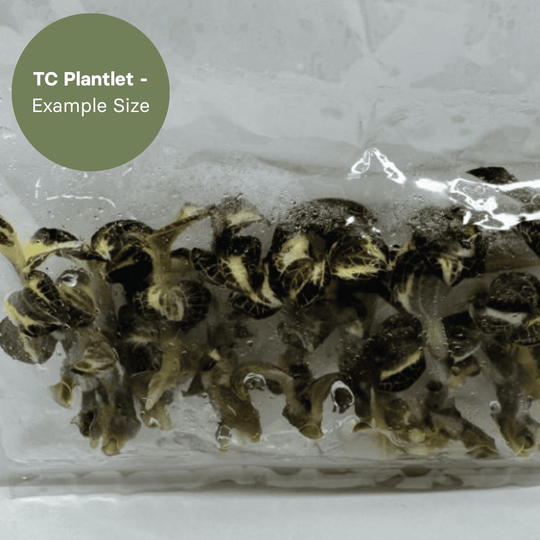
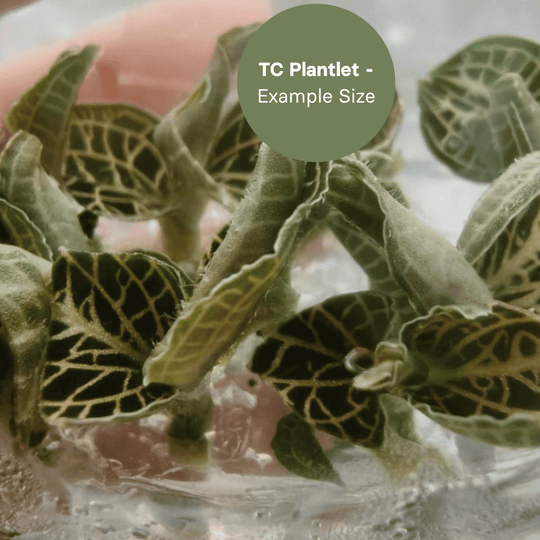
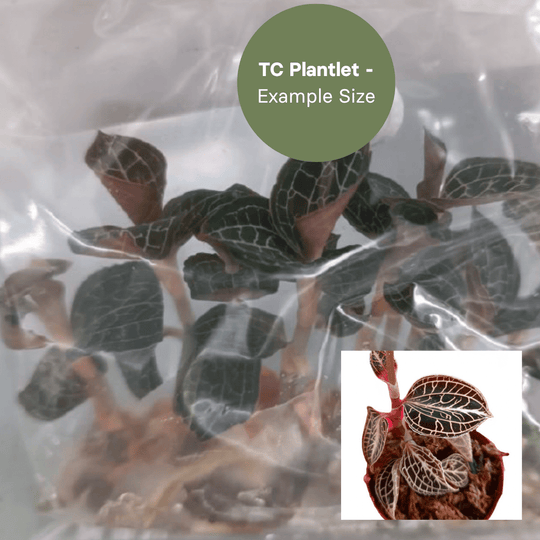
It is also worth knowing why so many of the rarer hybrids in our range start life as tissue-culture plantlets. Wild jewel orchid populations have been heavily collected, particularly in China and Taiwan, and propagating in the lab lets us build up healthy stock of a variety without taking anything from the wild.
Common Problems and How to Fix Them
Stem and crown rot
This is by far the most common way people lose a jewel orchid. It happens when water sits in the crown of the plant, or when the substrate is kept too wet for too long. The prevention is straightforward: water at the base rather than over the top, keep the crown itself dry, and make sure air is moving around the plant.
Fungal leaf spot
You will see this as dark spots on the leaves, sometimes ringed with yellow. It is caused by wet foliage sitting in still air. Remove any affected leaves promptly and stop watering from overhead.
The velvet has faded
This is almost always a light problem rather than anything more serious. Move the plant somewhere shadier and the new growth should come through in full colour. The older faded leaves will not recover, but they will be replaced in time.
Pests
Spider mites and mealybugs turn up occasionally, and they are much more likely to appear when humidity drops. Check the undersides of the leaves regularly so you catch them early. Because jewel orchid foliage is delicate, treat gently and always test any product on a single leaf first before treating the whole plant.

Jewel orchids reward attention to the small things. Steady moisture, high humidity and soft light are really all they ask for. Get those three right and you will have a long-lived, slow-building plant that genuinely gets more beautiful with every year that passes.