Never Never Plant
Ctenanthe Care Guide

These tropical foliage plants belong to the Marantaceae family, alongside the better-known Calathea and Maranta. They are native to the tropical forests of Central and South America, where they grow among the vegetation on the forest floor rather than out in full sun. That natural habitat gives us a useful starting point for their care: bright filtered light, warmth, consistent moisture and reasonably high humidity.
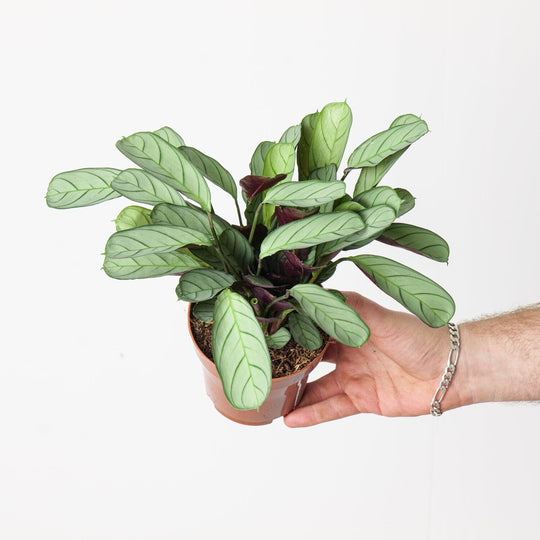
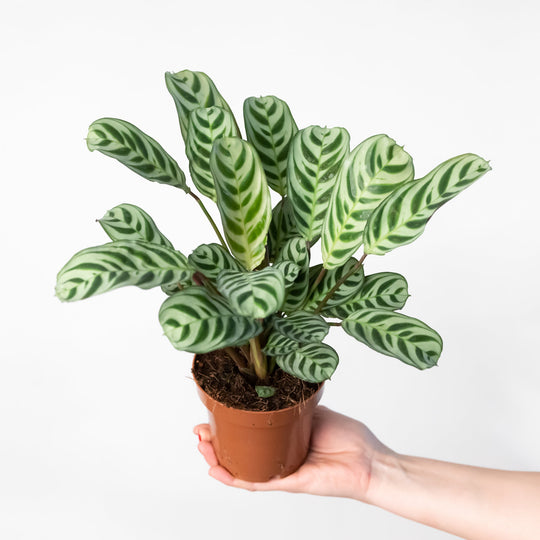
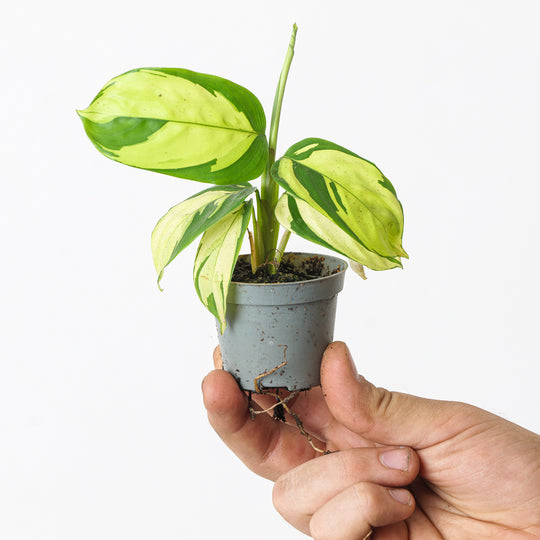
Their leaves are the main attraction. Depending on the species or cultivar, you might find silver fishbone markings, yellow brushstrokes or deep green patterns set against burgundy and purple undersides. Some also have the characteristic leaf movement associated with members of the Marantaceae family, with foliage changing position throughout the day.
Ctenanthe have a reputation for being a little particular, and there is some truth to that. They are less forgiving of a forgotten watering or a very dry room than a Pothos or Philodendron. The secret is consistency. Avoid letting the plant swing from bone dry to soaking wet, protect it from extremes of temperature and give it enough humidity to keep the foliage comfortable.
How much light does Ctenanthe need?
Ctenanthe grows naturally beneath a forest canopy, so bright, indirect light is ideal.
An east-facing window is a good place to start. A north-facing window can work too, particularly during the brighter summer months, although you may need to move the plant closer to the glass during winter when daylight levels drop.
South and west-facing windows can also work, but position the plant away from strong direct afternoon sun. Around 1 to 2 metres back from the glass is a useful starting point, although the ideal position will depend on the room and how much light reaches it.
Direct sunlight can scorch the leaves, leaving bleached or crispy patches that will not recover. On the other hand, a very dark corner can result in slower growth and less pronounced leaf markings.
If your Ctenanthe is producing increasingly plain-looking new leaves or stretching noticeably towards the window, try moving it somewhere brighter.
How often should you water Ctenanthe?
Ctenanthe likes its compost to remain slightly moist, but not saturated. During spring and summer, check the top few centimetres of compost every few days. When the surface has started to dry but the rootball still has some moisture in it, water thoroughly until excess water runs from the drainage holes.
During autumn and winter, growth naturally slows and the compost will take longer to dry. You can allow it to become a little drier between waterings, but avoid letting the plant sit completely dry for long periods.
There is no useful universal watering schedule because a plant in a warm, bright room will use water much faster than one growing several metres from a window in winter. Check the compost instead.
Does Ctenanthe need high humidity?
Yes. Humidity is one of the biggest factors to consider if you want Ctenanthe to look good all year rather than developing a collection of brown edges.
They will generally be happier when humidity is above around 50%, although the exact requirement varies between homes and cultivars. Heated rooms can become particularly dry during winter, which is when brown tips and curling leaves often become more noticeable.
There are several ways to improve the conditions around your plant.
Group your plants together. Several plants growing close to one another can create a slightly more humid microclimate.
Use a humidifier. This is the most reliable option if you have several humidity-loving plants or your home becomes particularly dry during winter.
Try a bathroom. A bright bathroom can be an excellent home for Ctenanthe, provided it has enough natural light.
A pebble tray can provide a small amount of local humidity, although it is not a substitute for a humidifier in a very dry room.
We would not rely on misting. It may temporarily wet the leaves, but it does not keep the surrounding humidity high for long and repeatedly wet foliage can encourage spotting if air circulation is poor.
What temperature does Ctenanthe need?
Warm and stable conditions suit Ctenanthe best. Normal indoor temperatures are generally fine, but avoid putting the plant beside a radiator, heater or draughty exterior door. Sudden changes in temperature can cause stress and may contribute to leaf curling and damage.
A position away from cold windows and draughts during winter is particularly helpful.
Think warm forest floor rather than tropical greenhouse. You do not need to keep your home exceptionally warm, but avoiding extremes will make caring for Ctenanthe considerably easier.
What is the best soil for Ctenanthe?
Ctenanthe do best in a houseplant mix that holds some moisture while still allowing plenty of air to reach the roots.
Simply Houseplant Mix is a great choice, providing a balanced growing medium for a wide range of indoor plants. It should retain enough moisture to keep the roots hydrated without becoming dense or waterlogged.

As always, make sure your pot has drainage holes to allow excess water to escape.
When should you repot Ctenanthe?
Ctenanthe can usually be repotted every one to two years, although the condition of the rootball is a better guide than the calendar.
If roots are beginning to emerge from the drainage holes, the plant is becoming tightly rootbound or the compost has broken down into a dense, water-retentive mass, it may be time for a refresh.
Spring is an ideal time to repot because the plant is heading into its active growing season.
Choose a pot only slightly larger than the existing one. A large pot may look like a generous upgrade, but all that extra compost can retain moisture around a relatively small root system and increase the risk of root problems.
This is also a good opportunity to propagate your Ctenanthe, as established plants naturally form clumps.
How do you propagate Ctenanthe?
Division is the easiest and most reliable way to propagate Ctenanthe at home.
When you remove the plant from its pot, look closely at the clump. You are looking for natural sections with their own roots and several healthy stems or growing points.
Gently separate these sections where they naturally come apart. If the roots and rhizomes are tightly joined, use a clean, sharp knife rather than pulling the plant apart and causing unnecessary damage.
Pot each division into fresh, appropriately sized compost and water it in thoroughly. Keep the new plants warm and humid while they establish.
Be patient with newly divided plants. They have had their root system disturbed and may take some time to produce obvious new growth.
Stem cuttings are not a reliable propagation method for Ctenanthe, so division is the method we recommend.
Common Ctenanthe problems
Brown leaf tips and edges
Brown tips are probably the most common issue with Ctenanthe.
Low humidity, inconsistent watering and mineral build-up can all contribute. If you are seeing persistent browning despite the compost being kept appropriately moist, consider the humidity around the plant and the quality of your water.
If your tap water is particularly hard, filtered water or collected rainwater may be worth trying.
You can trim damaged edges with clean scissors, following the natural shape of the leaf. The damaged tissue will not turn green again, but improving the conditions should help new leaves emerge without the same problem.
Yellowing leaves
One older leaf gradually turning yellow is not necessarily a problem. Like all plants, Ctenanthe eventually sheds older foliage.
If several leaves are yellowing together, particularly when the compost remains wet, check the roots and drainage.
Fading patterns
If new leaves are becoming less strongly patterned or the plant is looking generally washed out, check the light levels.
Move it somewhere brighter but continue to protect it from harsh direct sunlight. Good indirect light is particularly important if you want to maintain strong foliage markings.
Curling leaves
Check the compost first.
If it is dry, water the plant thoroughly and monitor how quickly it dries out afterwards. If the compost is already moist, look at humidity, temperature and light instead.
Leaf curling can be the plant's response to several different stresses, so it is worth looking at the whole growing environment rather than assuming that humidity is always the answer.
Spider mites
Spider mites thrive in warm, dry conditions, making them more likely to appear when central heating is running.
Look closely at the undersides of the leaves for fine pale speckling and, in more advanced infestations, delicate webbing around the leaf joints.
Mealybugs
Mealybugs often hide around leaf joints and in the sheltered areas between stems.
Small infestations can be dealt with by carefully removing individual insects with a cotton bud and an appropriate cleaning solution, followed by a suitable houseplant pest treatment. Keep checking for new insects over the following weeks.
The secret to happy Ctenanthe
Ctenanthe are sometimes labelled as difficult houseplants, but we think they are better described as plants that dislike being forgotten about.
They want bright, filtered light rather than a dark corner, moisture without waterlogging and humidity without needing to live inside a bathroom cabinet. Most importantly, they like things to stay fairly consistent.
Once you find a good spot and settle into a watering routine, they become much easier to understand. And when a new leaf unfurls with its markings intact and those rich purple undersides on show, the extra attention starts to feel rather worthwhile.
For care advice on other members of the Marantaceae family, take a look at our Calathea care guide and Maranta care guide.