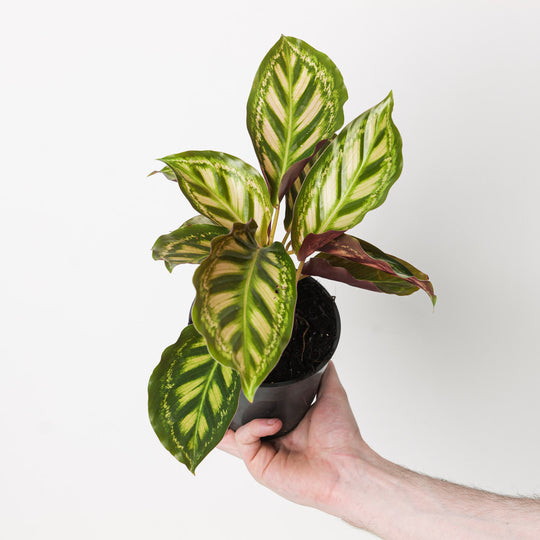
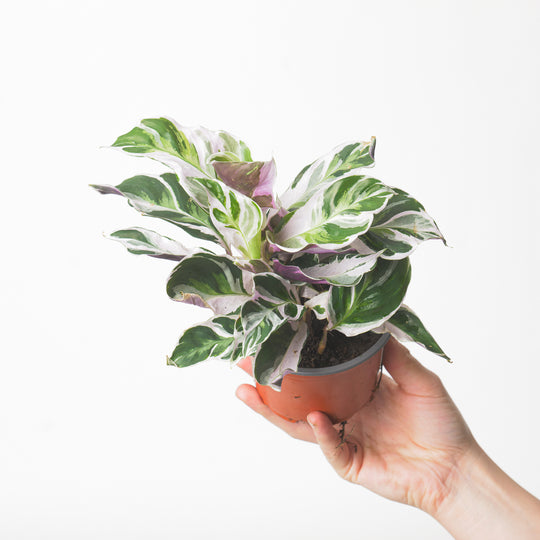
Calathea


Calathea plants are prized for their extraordinary foliage patterns, from bold stripes and painterly brushstrokes to delicate mosaic markings. Often called prayer plants for the way their leaves fold upward at night, Calathea (now reclassified under Goeppertia) are native to the tropical Americas and thrive in warm, humid indoor conditions.

Our collection includes over 40 varieties, from popular picks like Calathea orbifolia, Calathea 'Medallion', and Calathea musaica 'Network' to rare collector varieties such as Calathea White Fusion and 'Princess Dalya' Variegated. Most Calathea are non-toxic to cats and dogs, making them a popular choice for pet-friendly households.

41 products

    41 products

    Your Guide to Calathea and Prayer Plants

    Why Choose a Calathea?

    Calathea plants are all about the foliage. Each species and cultivar carries its own unique leaf pattern, from the silver-brushed rounds of Calathea orbifolia to the intricate geometric lines of Calathea musaica 'Network'. They bring colour and visual interest to shaded corners where many other houseplants would struggle. Most are also non-toxic to pets, which makes them a practical choice for homes with cats or dogs.

    Popular Calathea Varieties

    Calathea 'Medallion' is one of the most recognised varieties, with round, dark green leaves featuring a central medallion of lighter green and purple undersides. Calathea lancifolia 'Insignis' (Rattlesnake Plant) has long, wavy-edged leaves with dark spots, and is one of the more forgiving species. Calathea Ornata offers bold pink pinstripes on deep green leaves.

    For collectors, Calathea White Fusion delivers dramatic white and green marbled leaves, while 'Princess Dalya' Variegated and Yellow Fusion are rarer finds. We also carry closely related genera including Stromanthe 'Triostar' and Ctenanthe burle marxii.

    How to Care for Calathea

    Calathea prefer bright indirect light but cope well in moderate shade. Avoid direct sun, which bleaches and scorches the leaves. They like consistent moisture; water when the top 2 to 3 cm of compost feels dry. Use room-temperature water where possible, as cold water can shock the roots.

    Humidity is key. Group your Calathea together, place them on a pebble tray, or keep them in a naturally humid room like a bathroom or kitchen. Feed every two to four weeks with a balanced liquid fertiliser during spring and summer. Brown leaf tips usually signal low humidity rather than underwatering.

    Calathea for Beginners

    If you are new to Calathea, start with Calathea lancifolia 'Insignis' or Calathea 'Freddy'. Both handle average room humidity better than most and are less prone to crispy edges. Ctenanthe 'Amagris' is another excellent entry point from the wider prayer plant family.

    Pet-Friendly Houseplants

    The majority of Calathea, Stromanthe, and Ctenanthe species are considered non-toxic to cats and dogs, making this collection one of the safest choices for pet owners. Always check individual product pages for specific safety details. For more pet-safe options, browse our wider range of easy care houseplants.

    Frequently Asked Questions

    Calathea (recently reclassified as Goeppertia) are tropical foliage plants from the Marantaceae family, native to the Americas. They are commonly called prayer plants because their leaves fold upward at night and open again in the morning. The family also includes closely related genera such as Stromanthe and Ctenanthe.

    They are grown primarily for their stunning leaf patterns, which range from stripes and spots to intricate mosaics. Most are compact enough for shelves, tabletops, and windowsills.

    Calathea lancifolia 'Insignis' (Rattlesnake Plant) is one of the most forgiving varieties. It tolerates average room humidity better than most Calathea and is less prone to brown leaf tips. Calathea 'Freddy' is another resilient choice with attractive striped foliage.

    From the wider prayer plant family, Ctenanthe 'Amagris' and Ctenanthe 'Compact Star' are equally undemanding and share the same appealing leaf movement.

    Place in bright indirect light or moderate shade. Water when the top 2 to 3 cm of compost feels dry, using room-temperature water. Calathea are sensitive to chemicals in tap water; if you notice brown tips, try filtered or rainwater.

    Humidity is essential. Group plants together, use a pebble tray, or position in a naturally humid room. Feed every two to four weeks with a balanced liquid fertiliser during spring and summer. Wipe leaves gently to remove dust.

    No. Calathea naturally grow on the forest floor under a canopy, so they prefer moderate to low indirect light. Most varieties, including 'Medallion' and Calathea makoyana, do well in north-facing rooms or a few metres back from brighter windows.

    Variegated types like White Fusion benefit from slightly brighter indirect light to maintain their markings. Avoid direct sun through south-facing windows, as this will scorch and fade the leaves.

    Yes, the vast majority of Calathea, Stromanthe, and Ctenanthe species are considered non-toxic to cats and dogs. This makes them one of the safest plant families for pet-friendly homes.

    As always, check individual product pages for specific safety information, as some closely related species may differ. For more pet-safe options, browse our wider Easy Care collection.

    Brown leaf tips on Calathea almost always point to low humidity. These plants evolved in tropical rainforests and prefer humidity levels above 50%. Grouping plants together, using a pebble tray, or moving them to a bathroom or kitchen can help.

    Tap water with high chlorine or mineral content can also cause brown edges. Try switching to filtered or rainwater. Ensure you are not placing your Calathea in direct sunlight or near a radiator, as both dry the air and stress the foliage.