Boston Fern
Nephrolepis Care Guide

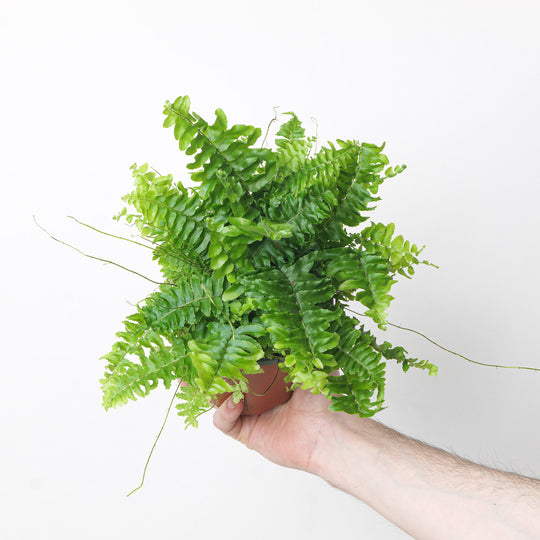
Nephrolepis exaltata, the Boston fern, is the most widely sold fern in the UK and with good reason. It is more forgiving than most of its relatives, can handle lower light than the label suggests, and produces dense, arching fronds that soften any shelf or hanging position. The single biggest factor in keeping it healthy indoors is humidity. Get that right and most other problems become far less likely.
This guide covers the full care picture: light, watering, humidity, soil, repotting, propagation, the varieties worth knowing, and the problems our horticultural team hears about most often.
Boston Fern Requirements
The ideal position for a Boston fern is bright indirect light, away from direct sun. An east or north-facing window works well, as does a spot set back one to two metres from a south or west-facing one. Nephrolepis exaltata originates from humid tropical forests, where it grows in filtered light beneath the canopy, so it is well adapted to the lower light conditions typical of UK interiors.
Direct sun, on the other hand, is genuinely damaging. Even a few hours of harsh afternoon sun will scorch the fronds, causing bleached, papery patches that will not recover. If your fern sits in the sun's direct path, move it, and be especially watchful in summer when the light is at its strongest.
Too little light causes problems of its own. Growth becomes sparse, the fronds come through small and pale, and new shoots arrive very slowly. A useful rule of thumb is this: if a Boston fern has not produced a single new frond in three months during the growing season, it needs more light.
How Often to Water a Boston Fern
The rule: Keep the compost consistently moist. Boston ferns do not have the same drought tolerance as many tropical houseplants; the root ball should never be allowed to dry out completely. During spring and summer, check the soil every two to three days, watering whenever the surface feels dry to the touch but before the compost has dried deeply.
In autumn and winter: Reduce frequency but do not stop entirely. The plant's growth slows but it still needs moisture. Aim to keep the compost just lightly moist, checking roughly once a week.
Signs of overwatering: Yellowing fronds across the whole plant, particularly if accompanied by a stale smell from the compost. Ensure the pot has drainage holes and that water does not sit in a saucer for extended periods.
Signs of underwatering: Fronds droop and the entire plant looks limp, followed by rapid frond drop if the soil remains dry. This is recoverable if caught early; place the pot in a basin of room-temperature water for 20 to 30 minutes, allow it to drain fully, and move it back to its position. Expect new fronds to appear within a few weeks.
Ideal humidity for Boston Fern
This is the most important factor for Boston ferns and the one most commonly underestimated. Nephrolepis exaltata prefers humidity of 60 per cent or above. Most UK homes in winter, with central heating running, sit around 30 to 40 per cent. This gap is where most fern problems begin.
Practical solutions for a UK home:
- Position the plant in a naturally humid room. A bathroom with good natural light or a kitchen near the sink and away from the hob are both good options.
- Pebble tray: Set the pot on a wide tray of pebbles filled with water. As the water evaporates it raises local humidity around the plant. Keep the water topped up and ensure the pot base is not sitting directly in the water.
- Grouping plants: Placing several humidity-loving plants together creates a small microclimate. Browse our humidity-loving houseplants collection for companions that will benefit from the same environment.
- Humidifier: The most reliable solution if you have multiple humidity-sensitive plants. A small ultrasonic humidifier placed nearby during the heating season makes a substantial difference.
We do not recommend misting. Misting has minimal effect on ambient humidity and can encourage fungal issues on the fronds if water sits on the surface.
What Potting Mix is best for Nephrolepis?
Boston ferns need a potting mix that stays consistently moist but does not become waterlogged. A peat-free mix with good water retention and enough structure to allow some airflow around the roots is ideal.
Our Fern Premium Potting Mix is formulated specifically for ferns and related plants. It holds moisture well while still allowing excess water to drain, which is the balance these plants need. Avoid heavy, dense composts that compact over time, and avoid mixes formulated for cacti or succulents which drain too freely for fern roots.

A layer of sphagnum moss worked into the top of the pot can help retain surface moisture, which benefits plants in lower-humidity environments.
Repotting
Repot annually in spring (March to May) when the plant is entering its active growing period. You will know it is ready when roots are visibly emerging from the drainage holes or the plant dries out unusually quickly after watering.
Move up by one pot size. Terracotta pots work well for Boston ferns because they are slightly porous and help prevent overwatering, but any pot with good drainage is suitable. Refresh the compost fully when repotting rather than simply topping up around existing rootbound compost.
Handle the root ball carefully. Nephrolepis roots are fine and dense and can be damaged easily. If you notice dead or very dark, mushy roots during repotting, trim these back to healthy white tissue before repotting into fresh compost.
Propagating Nephrolepis
Division: The most straightforward method. A mature Boston fern will produce offsets and multiple crowns over time. When repotting, these can be carefully separated, ensuring each division has a portion of roots and several fronds. Pot individually in fresh fern mix and keep humidity high until new growth establishes.
Runners (stolons): Nephrolepis produces wiry runners that extend from the base of the plant. These can be pinned down into a small pot of compost placed adjacent to the parent plant. Once the runner produces roots and new fronds, it can be cut from the parent and grown on independently.
Both methods work best in spring and early summer. Avoid attempting propagation in winter when the plant is growing slowly.
Common Problems when growing Nephrolepis
Brown, crispy frond tips
Brown, crispy tips are almost always caused by low humidity combined with dry air from central heating. The fix is raising the humidity around the plant, not increasing how often you water it. The two are easy to confuse but behave very differently.
Yellow fronds
Older fronds at the base of the plant turning yellow is natural and expected, and nothing to worry about. If the whole plant is yellowing, however, check for overwatering first, and then consider whether it has been sitting in the same compost for more than twelve months, as the nutrients may simply be depleted by that point.
Frond drop
Sudden frond drop usually follows a sudden change in conditions, such as a cold draught, a move to a new position, or the root ball being allowed to dry out completely. The best prevention is consistency: keep the plant's conditions steady and avoid placing it near doors, windows, or radiators.
Pests
Boston ferns can attract fungus gnats if the compost stays too wet, so allow the surface to dry out between waterings during winter to reduce the risk. They are also occasionally affected by scale on the stems, which is best treated early with a soft cloth and horticultural soap as soon as it is spotted. Our bathroom plants collection includes companions that suit the same humid conditions.
Our horticultural team is happy to help with any care questions, so please use the contact page to get in touch.
Ready to grow your Ferns Collection?
If the Boston fern has won you over, it is only the beginning. Ferns are one of the most rewarding plant families to collect, ranging from tough, forgiving houseplants to delicate terrarium miniatures, and once you have the humidity right for one, you have created the conditions for many more. Whether you are after a dramatic hanging specimen for the bathroom, a textural companion for your existing tropicals, or something rarer for an enclosed setup, there is a fern to fit.