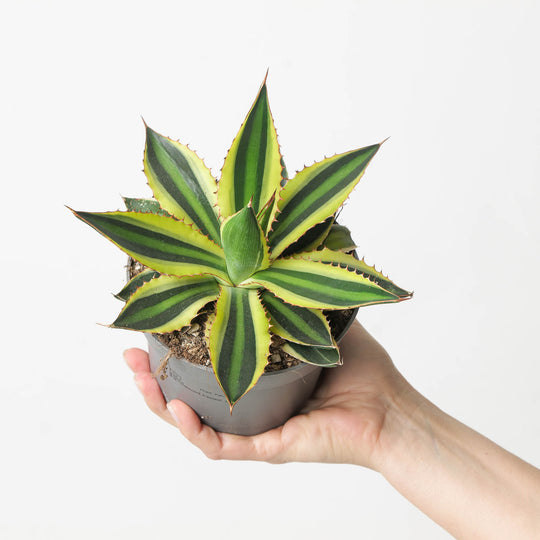
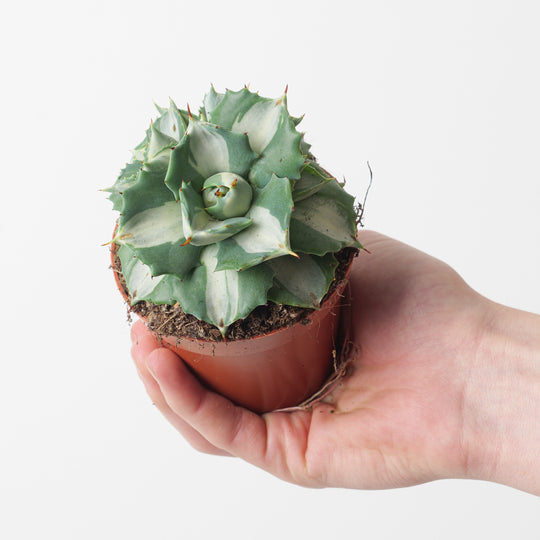
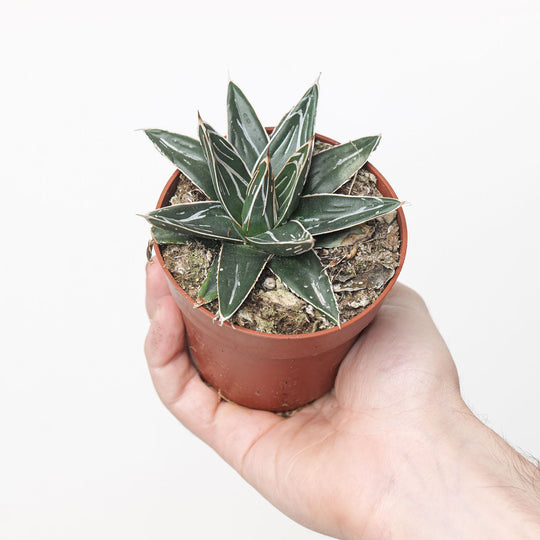
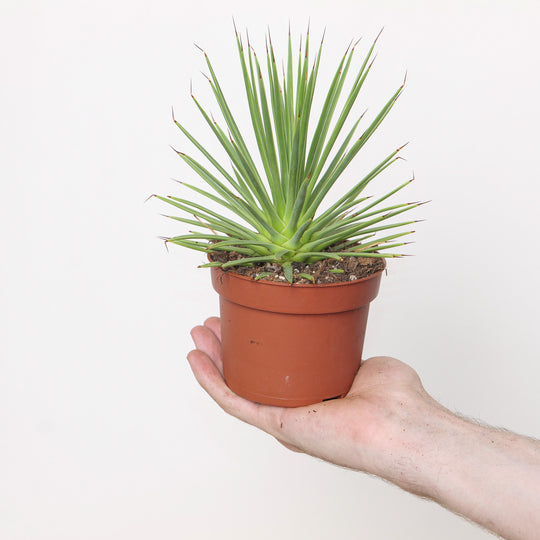
Agave
Agave Care Guide

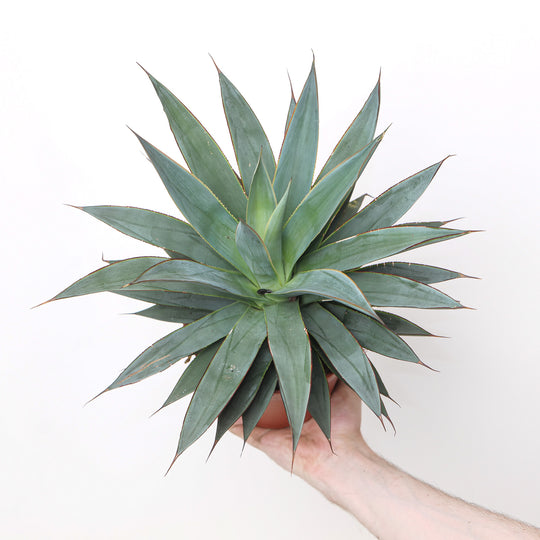
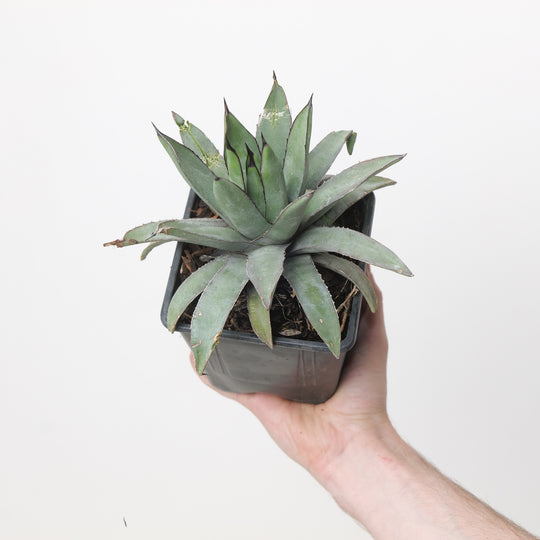
Agave is one of the most architectural plants you can grow indoors.
It's stiff, sculptural rosettes are often with hooked teeth and a sharp terminal spine, and in many species a striking white or yellow leaf margin.
The care is simple if you remember the single most important thing... Agave hates being wet.
This guide covers the light, watering, soil, dormancy, propagation, and varieties we stock at the nursery, plus the mistakes we see most often with indoor Agave.
Light Requirements
The ideal spot for Agve is the brightest spot you have. A south-facing windowsill is best. West-facing also works. Variegated forms hold their colour better in strong light.
Agave will tolerate medium light short-term, but it will not thrive there. Expect etiolation, pale weak growth, and a higher risk of rot in winter. If your home is on the shadier side, a basic LED grow light makes a huge difference; this is one of the genera where supplemental lighting is genuinely useful in the UK.
How Often to Water Agave
Our top tip would be to water deeply, then let the compost dry out completely before watering again.
In spring and summer, water throughly every 14 to 21 days, depending on pot size, heat, and how much sun the plant is getting. Water until it runs out the drainage hole, then tip the saucer empty.
In autumn and winter, water every 6 to 8 weeks, sometimes less. The combination of cool temperatures, low light, and wet roots is the single biggest killer of indoor Agave. In our experience, a dry Agave in January is rarely a problem; a wet one almost always is.
Repotting
Agave needs a mineral-rich, fast-draining substrate. Standard houseplant compost retains far too much moisture and will rot the roots within a season.
We use our Desert Mix or Simply Cacti as the base, often cut with extra coarse pumice for the larger species.
Terracotta pots are a strong choice for Agave. They breathe, dry out faster than plastic, and the weight helps balance top-heavy plants.
Repot every two to three years in spring, going up one pot size only. Most Agaves are slow-growing and prefer being slightly snug. Use leather gloves; the spines on the leaf tips and margins are sharp.
After repotting, do not water for at least a week. This lets any roots damaged in the process dry and callus, which significantly reduces the risk of rot.
Dormancy and Winter Care
Agave slows right down from late October until early spring. It is not strictly dormant indoors, but growth more or less stops. Adjust care to match:
- Cut watering back hard. Once every six to eight weeks is fine for most plants.
- Move to the brightest possible spot.
- Stop feeding entirely.
- Keep away from cold draughts but cool nights (down to about 5°C for hardy species, 10°C for the more tropical ones) are tolerated and can even encourage flowering in mature plants.
Propagation
Most Agave species produce offsets, also called pups, around the base of the parent plant. This is the practical home method.
- Wait until the offset has formed several leaves and ideally its own small root system at the base.
- Carefully scrape away the surface compost to expose where it joins the parent.
- Use a clean sharp knife to separate it cleanly.
- Leave the cut surface to dry for one to two days in a warm, airy spot. This calluses the wound and prevents rot.
- Pot up into dry, free-draining cacti mix. Keep dry for a week, then water sparingly.
Mature plants can also be grown from seed, but it is a slow process and many of the variegated cultivars do not come true from seed.
Feeding
Agave is not a hungry plant. Feed once a month from April to September with a low-nitrogen cactus and succulent fertiliser at half strength. Skip feeding entirely from October to March. Over-fed Agaves push out lush, soft growth that is more prone to rot and damages the natural compact form.
Pets, Children, and Safe Placement
Two things to know. First, the spines are sharp and can cause real puncture injuries; keep larger Agaves off the floor in homes with crawling toddlers. Second, the sap is irritant and can cause contact dermatitis, especially in Agave americana. Wear gloves when repotting or removing offsets, and wash hands after handling cut surfaces.
Common Problems
Rot at the centre of the rosette: water has sat in the crown. Improve drainage, water at the base rather than over the plant, and keep the rosette dry.
Brown soft spots on leaves: usually cold damage combined with damp. Move to a warmer brighter spot and reduce watering.
Stretched pale growth: not enough light. Move closer to the brightest window or add a grow light.
Mealybugs: can hide deep in the crown and between leaf bases. Inspect with a torch monthly. Treat at first sight with isopropyl alcohol on a cotton bud and read our full guide on managing mealybugs.
Suddenly producing a giant flower spike: congratulations, your plant has reached flowering size. The parent rosette will die after flowering, but it usually leaves behind a generation of offsets to take its place.