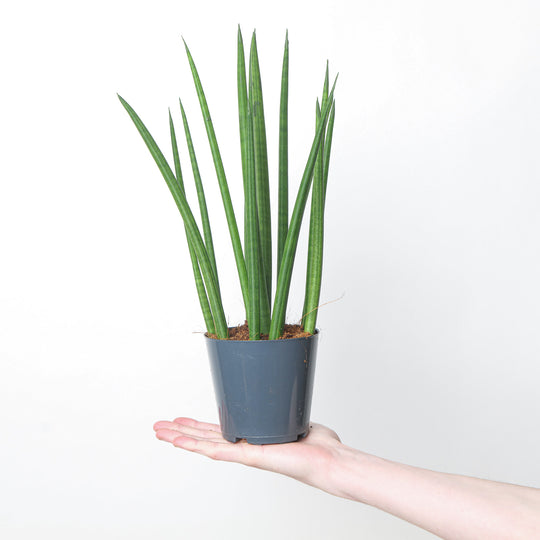
Snake Plant
Sansevieria & Snake Plant Care Guide

Snake plant care is straightforward once you understand one thing: these plants are succulents, not tropicals. Sansevieria (also known as mother-in-law's tongue, and now reclassified under Dracaena, though most growers still use the old name) stores water in its thick, upright leaves. The number one mistake people make is treating them like moisture-loving houseplants. Get the watering right and everything else follows.
This Sansevieria care guide covers light, watering, snake plant soil, repotting, propagation, and common problems for snake plant care indoors. It's written by our horticultural team and based on how we grow Sansevieria in our own nursery.
Light Requirements
Snake plants tolerate a wide range of light conditions, which is why they're recommended for beginners. But "tolerates" and "thrives" are different things.
Ideal light: Bright, indirect light for 8 to 10 hours a day. An east- or west-facing windowsill is perfect. Snake plants will also do well a metre or two back from a south-facing window.
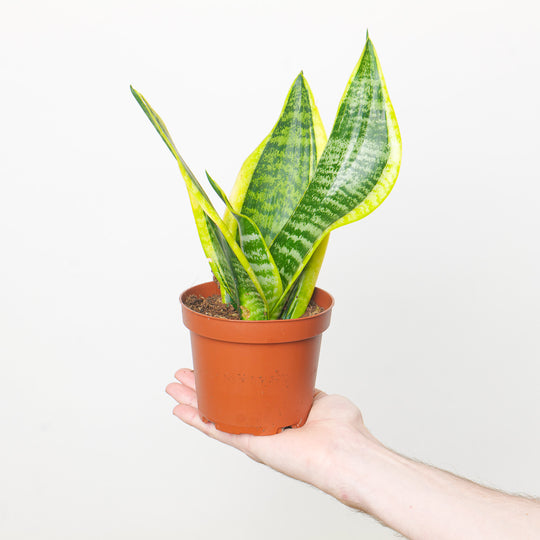
Low light: Sansevieria will survive in low light, but growth slows dramatically and variegation fades. If your Sansevieria trifasciata 'Laurentii' is losing its yellow edges, it needs more light.
Direct sun: A few hours of gentle morning or late afternoon sun is fine. Avoid harsh midday direct sun through south-facing glass, especially in summer. It can scorch the leaves, leaving bleached patches that don't recover.
Signs your snake plant needs more light:
- New leaves are thinner and paler than older growth
- The plant leans toward the light source
- Variegated varieties (Laurentii, Moonshine) lose their colouring
- Growth stalls completely for months outside of winter
How Often to Water a Snake Plant
Snake plant watering is the single most important thing to get right. Overwatering is the most common way people kill snake plants. The leaves are thick and fleshy because they store water. In their native habitat (dry, rocky regions of West Africa), they survive long periods without rain.
The rule: Let the soil dry out completely between waterings, then water thoroughly. In practice, this means:
- Spring and summer (active growth): Water every 2 to 3 weeks. Check the soil first. If it's still damp 5cm down, wait.
- Autumn and winter: Water once every 4 to 6 weeks. Growth slows and the plant uses far less moisture.
- Heated homes in winter: Central heating dries soil faster. You may need to water slightly more often than the 6-week guideline suggests, but always check the soil first.
How to water: Water the soil directly, not the centre rosette. Allow excess water to drain fully from the pot. Never leave a snake plant sitting in a saucer of water.
Signs of overwatering: Soft, mushy leaves at the base. Yellow leaves, especially lower ones. A foul smell from the soil (this indicates root rot). If you catch it early, unpot the plant, remove any black or mushy roots, let the root ball dry for 24 hours, and repot into fresh, well-draining mix.
Signs of underwatering: Wrinkled or slightly curling leaves. Brown, crispy leaf tips. The plant is more forgiving of drought than excess moisture, so when in doubt, wait a few more days before watering.
Soil and Potting Mix
Snake plants need a fast-draining mix that doesn't hold moisture for long. Standard houseplant compost retains too much water for Sansevieria and increases the risk of root rot.
What to use: A cactus and succulent mix works well. You can also mix your own using roughly equal parts of standard houseplant compost and a drainage amendment like perlite, pumice, or coarse sand.
We use our own peat-free substrates for all the Sansevieria we grow in the nursery. A blend of coco coir and coco chips with perlite gives the right balance: enough structure to anchor the roots, fast drainage to prevent waterlogging, and organic matter that breaks down slowly. If you're mixing your own, aim for roughly 60% inorganic (perlite, pumice, grit) and 40% organic (coco coir, compost).
Pot choice: Always use a pot with drainage holes. Terracotta is ideal for snake plants because it's porous and allows moisture to evaporate through the walls, reducing the risk of soggy roots. Plastic pots work too, but you'll need to be more careful with watering frequency.
Repotting
Snake plants are slow growers and don't need frequent repotting. Every 2 to 3 years is typical, or when you see roots circling the bottom of the pot or emerging from drainage holes.
When to repot: Spring is best (March to May in the UK). The plant is entering its active growth period and will recover quickly.
How to repot:
- Choose a pot one size up (roughly 2 to 3cm wider in diameter). Don't jump to a much larger pot as the excess soil holds moisture the roots can't use.
- Remove the plant and gently tease apart the root ball. Trim any dead or mushy roots with clean scissors.
- Add fresh, well-draining mix to the base of the new pot. Position the plant at the same depth it was growing before.
- Fill around the roots, firming gently. Water lightly and let the soil settle.
- Don't water again until the soil has dried out.
This is also a good time to separate any snake plant pups (offsets) growing at the base. Each pup with its own root system can be potted up independently.
Propagation
Snake plant propagation is satisfyingly easy. There are two reliable methods.
Division (fastest results): When you repot, look for pups growing from the rhizome at the base. Separate them with a clean, sharp knife, making sure each division has roots attached. Pot into individual containers with well-draining mix. These will establish quickly because they already have a root system.
Leaf cuttings (slower but rewarding): Cut a healthy leaf into 8 to 10cm sections. Let the cut ends callous over for 24 to 48 hours (this prevents rot). Place the cuttings upright in a well-draining mix (cactus soil with extra perlite works well), making sure the original bottom end faces down. Each cutting should sit about 2cm deep. Keep the soil barely moist and wait. New roots and plantlets emerge from the base of each cutting in 4 to 8 weeks.
Important note on variegated varieties: Leaf cuttings from variegated cultivars like Laurentii will typically revert to solid green. The yellow margin is a chimeral trait that isn't reliably reproduced from leaf tissue. If you want to keep the variegation, propagate by division instead.
Snake Plant Types Worth Knowing
Sansevieria is a large genus with considerable variation. Here are the main types you'll encounter, all of which follow the same basic care principles outlined above:
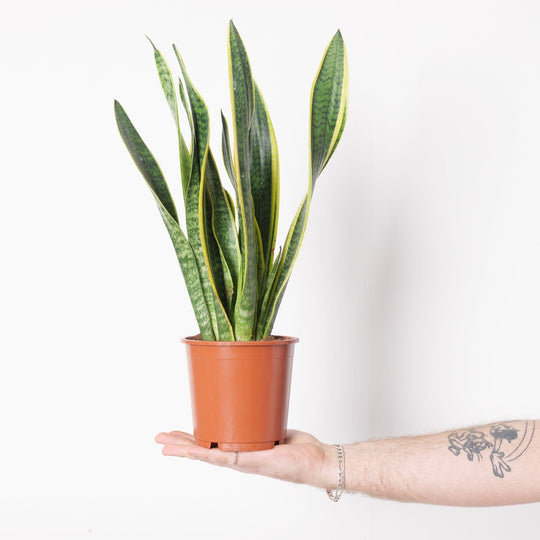
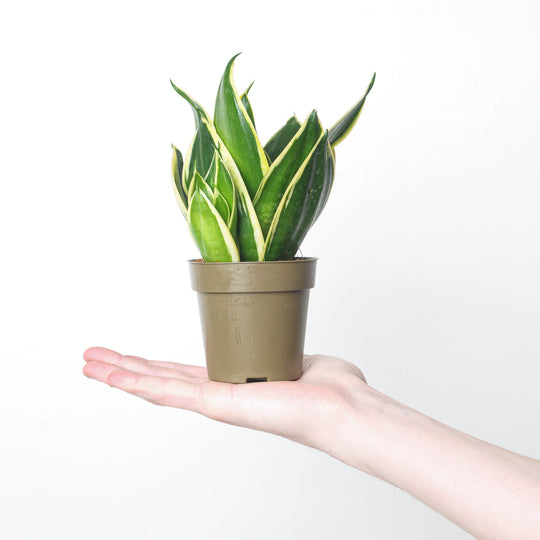
- Sansevieria trifasciata 'Laurentii' — the classic snake plant with yellow-edged leaves. The one most people picture. Shop Laurentii.
- Sansevieria trifasciata 'Moonshine' — silvery, pale green leaves. More subtle and increasingly popular with collectors. Shop Moonshine.
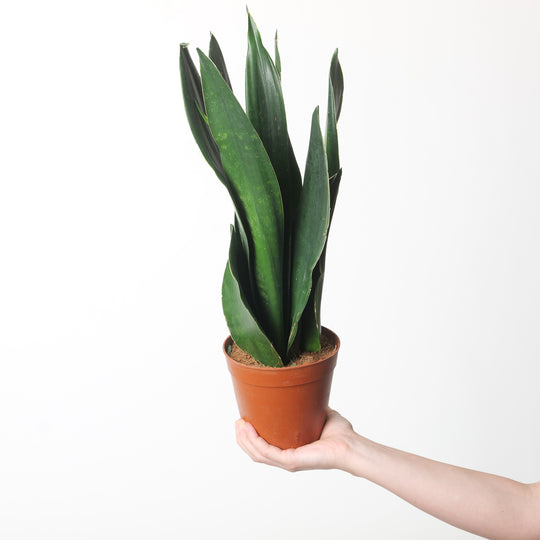
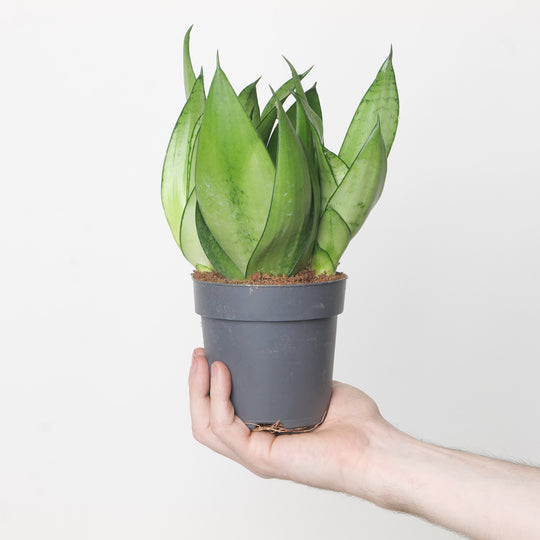
- Sansevieria trifasciata 'Black Coral' — deep green, almost black leaves with subtle banding. Shop Black Coral.
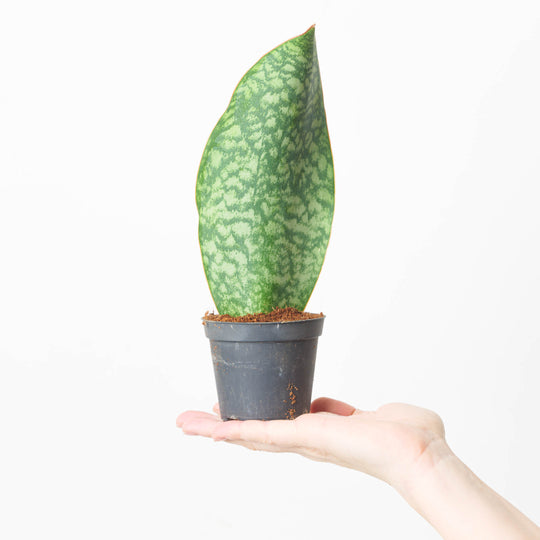
- Sansevieria masoniana (Whale Fin) — a single, broad, paddle-shaped leaf. Architectural and unusual. Shop Whale Fin.
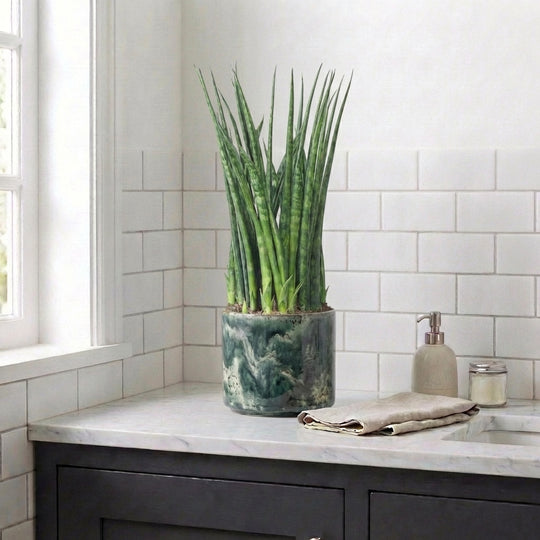
- Sansevieria cylindrica — cylindrical, spear-like leaves rather than flat blades. Striking in modern interiors.
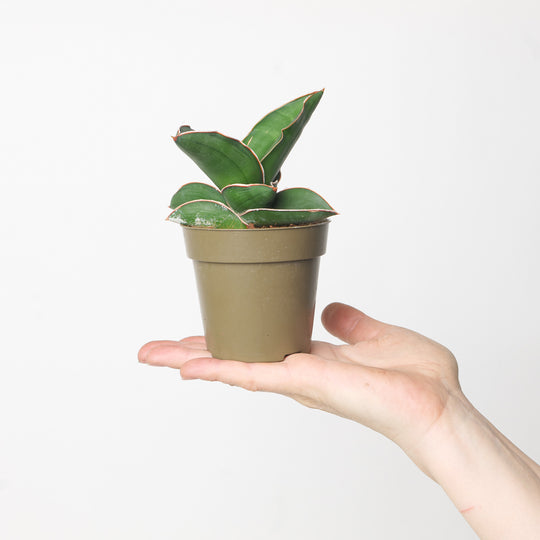
- Sansevieria hahnii (Bird's Nest) — compact, rosette-forming. Stays small, good for shelves and desks. Shop Hahnii.
- Sansevieria 'Golden Flame' — newer cultivar with striking golden-yellow leaves. Shop Golden Flame.
- Sansevieria trifasciata 'Metallica' — subtle metallic sheen on the leaves. Shop Metallica.
All of these share the same core care requirements: infrequent watering, well-draining soil, and moderate to bright indirect light. The main differences are in size, shape, and how much light they need to maintain their colour.
Browse our full snake plant collection to see what's currently in stock.
Temperature and Humidity
Snake plants are undemanding when it comes to both temperature and humidity, which is part of what makes them so well-suited to UK homes.
Temperature: 15 to 27°C is the comfortable range. They'll tolerate brief dips to 10°C, but sustained cold causes damage. Keep them away from cold draughts (single-glazed windows in winter, exterior doors) and don't leave them on cold windowsills overnight between November and March.
Humidity: Low to moderate humidity is fine. Snake plants are native to arid environments and don't need high humidity. Standard UK indoor humidity (40 to 60%) is perfectly adequate. No pebble trays, no grouping, no humidifiers needed for these.
Feeding
Snake plants are light feeders. Over-fertilising causes more problems than under-fertilising.
When to feed: April to September (the growing season). Once a month with a balanced liquid houseplant fertiliser diluted to half the recommended strength.
When not to feed: October to March. The plant is resting and doesn't need additional nutrients. Feeding during dormancy can cause salt build-up in the soil, which damages roots.
Signs of over-feeding: Brown leaf tips, white crusty deposits on the soil surface, and wilting despite adequate watering. If you suspect salt build-up, flush the soil thoroughly with water and hold off feeding for a couple of months.
Common Problems and Troubleshooting
Yellow Leaves
The most common cause is overwatering. Check the soil. If it's damp and the leaves are soft or mushy at the base, the roots may be rotting. Unpot, remove damaged roots, let the root ball dry, and repot in fresh mix.
If the soil is dry and only the oldest (lowest) leaves are yellowing, this is natural leaf senescence. The plant is redirecting energy to new growth. Remove the yellowed leaves cleanly at the base.
Drooping or Leaning Leaves
Usually caused by overwatering, root rot, or insufficient light. A healthy snake plant holds its leaves rigidly upright. If leaves are drooping and soft, check for root rot. If they're leaning but firm, the plant is reaching for light. Rotate the pot a quarter turn each time you water to encourage even growth.
Brown Leaf Tips
Most often caused by inconsistent watering (alternating between bone dry and soaked) or low humidity combined with high temperatures. Trim the brown tips with clean scissors at a slight angle to mimic the natural leaf shape. Address the underlying cause to prevent recurrence.
Mushy Base
This is almost always root rot from overwatering or sitting in water. Act quickly: remove the plant from its pot, cut away all soft, black, or mushy tissue with a sterile blade, let the remaining healthy tissue dry for 24 hours, and repot into a completely fresh, dry mix. Don't water for a week after repotting.
Pests
Snake plants are largely pest-resistant. Mealybugs occasionally appear in leaf crevices (look for white, cottony clusters). Wipe them off with a cotton bud dipped in rubbing alcohol. Spider mites are rare but can occur in very dry, warm conditions. A firm shower spray dislodges them. For persistent infestations, treat with neem oil or an insecticidal soap.
Snake Plant Benefits
Beyond being low-maintenance, snake plants are one of the few houseplants that are reported to convert CO₂ to oxygen at night (via CAM photosynthesis). This makes them a solid choice for bedrooms. NASA's Clean Air Study also identified Sansevieria trifasciata as effective at filtering formaldehyde, benzene, and other common indoor pollutants, though the practical air-purifying effect in a normal-sized room is modest.
They're also structurally striking. The upright, architectural form works in almost any interior, from minimalist modern spaces to traditional rooms. They take up very little floor space relative to their visual impact.
One caveat: snake plants are mildly toxic to cats and dogs if ingested. The saponins in the leaves can cause nausea and vomiting. Keep them out of reach of curious pets, or choose a pet-safe plant instead.
Quick Care Summary
| Aspect | Details |
|---|---|
| Light | Bright indirect is ideal. Tolerates low light; avoid harsh direct sun. |
| Water | Let soil dry completely. Every 2–3 weeks in summer, 4–6 weeks in winter. |
| Soil | Fast-draining: cactus mix, or coco coir + perlite blend. |
| Temperature | 15–27°C. Avoid cold draughts below 10°C. |
| Humidity | Low to moderate. No special requirements. |
| Feeding | Half-strength liquid feed monthly, April to September only. |
| Repotting | Every 2–3 years in spring. One size up. |
| Propagation | Division (keeps variegation) or leaf cuttings (reverts to green). |
| Toxicity | Mildly toxic to pets. Keep out of reach. |
Need Help?
If your snake plant isn't behaving as expected, get in touch. Email us at hello@growtropicals.com or reply to your order confirmation. Jack and the horticultural team answer personally within 24 hours.