Living Stones
Lithops Care Guide

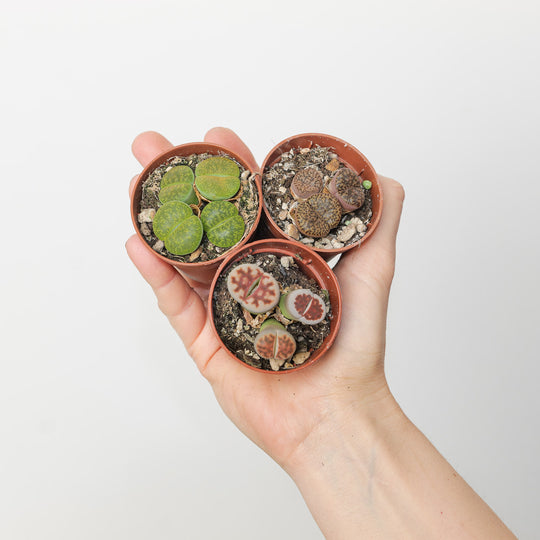
Lithops look like split pebbles and behave like nothing else on your windowsill. The single most important thing to know: for most of the year, they need no water at all. Far more of them are killed by a well-meaning watering can than by neglect.
This guide covers light, the annual watering cycle, the right substrate, repotting, growing from seed, the species worth knowing, and the problems we see most often at our nursery.

What lighting is best for Lithops?
Lithops need the brightest spot you can give them. An unshaded south-facing windowsill is the starting point rather than a compromise, because these plants grow in the arid interior of South Africa and Namibia, wedged between stones in full sun, and even the best UK windowsill delivers only a fraction of that light, especially in winter.
They do, however, have some tolerance. A plant in a west-facing or east-facing window will survive, but it will not stay compact. Once a Lithops receives less than roughly four hours of direct sun a day, the body begins to stretch upward, loses its flat top surface, and gradually takes on the look of a small column. This stretching, known as etiolation, is permanent: the plant will never shrink back down to its original shape, so it is worth getting the placement right from the start.
You can recognise insufficient light by a few clear signs. The bodies become elongated and pale, the gap between the two leaves widens, and the translucent "window" pattern on the top face begins to fade or disappear.
Too much light is genuinely rare indoors, but it can happen when a plant is moved abruptly from a dim shelf straight into strong summer sun. In that case the top surface can scorch, which shows up as corky brown patches. When relocating a Lithops to a brighter position, move it gradually over about a fortnight rather than in a single step.
How Often to Water Lithops
Water Lithops only when the plant is actively growing, and never while it is splitting. In practice, for most UK homes, that means a handful of waterings between late spring and early autumn, and nothing at all from roughly November to March.
Lithops run on an annual cycle that is worth learning, because it dictates their success:
- Autumn (September to November): flowering season. A single daisy-like flower emerges from the fissure between the leaves. Water sparingly, roughly once every two to three weeks, only if the soil is bone dry.
- Winter (December to February): the new pair of leaves is forming inside the old pair. Stop watering completely. The plant is drawing water and nutrients out of the old leaves to build the new ones. Watering now interrupts that and causes the old leaves to stay plump and rot.
- Spring (March to May): the old leaves shrivel to papery husks and the new bodies emerge. Still no water until the old leaves are completely dry and paper-thin. Then you can start again.
- Summer (June to August): in the hottest weeks many Lithops go semi-dormant. Water only if the bodies look visibly wrinkled, and only lightly.
When it is time to water, water deeply by soaking the pot until water runs from the drainage hole, then let it dry out completely. Little sips encourage shallow roots. This is one of the few plants where "a good drench, then forget about it" is literally the correct instruction.
Overwatering shows itself in ways that are hard to miss. The body may split open sideways, feel soft or squashy to the touch, or turn translucent and yellow at the base. Unfortunately, once a Lithops has split and gone mushy, it is usually beyond saving as the damage to the plant's water-storage tissue is too severe to recover from.
Underwatering, by contrast, is a much gentler problem. During the growing season, a thirsty Lithops develops deep wrinkles and takes on a soft, slightly deflated feel. This is easily fixed with a drink, and the plant will plump back up within days. There is one important exception, though: a wrinkled Lithops in February is completely normal. At that time of year the plant is consuming its old leaves from the inside as part of its natural cycle, and it should be left entirely alone.
In our experience, this plant copes far better with a forgotten summer than with an attentive winter. Neglect rarely kills a Lithops; kindness often does. If you are the sort of person who waters on a schedule, the safest strategy is to put your Lithops somewhere you simply will not see them between November and March — out of sight, out of mind, and out of danger.
What Potting Mix is best for Lithops?
Lithops need a substrate that holds almost no water. Standard houseplant compost is unsuitable because it is too fine, too peaty, and stays wet far too long around a tap root that has evolved to expect dryness. In habitat, these plants grow in gritty, fast-draining mineral soil, and the potting mix needs to reproduce that as closely as possible.
Our Desert Mix is a Premium Cacti & Succulent Potting Mix designed to allow for maximum drainage with some water retention to ensure good root growth without root rot. It's composed primarily of calcined molar clay, fine bark, sand and pumice.

Repotting
Lithops have a surprisingly long tap root and a deep pot suits them better than a wide one. A 7cm to 9cm pot at least 10cm deep will house a small cluster for years.
Repot in late spring, after the old leaves have fully shrivelled and the new bodies are established. Never repot in winter as this can cause stress.
Tip the plant out, tease away the old substrate, trim any dead root, then replant at the same depth. The junction between body and root should sit at soil level, not below it. Burying the body invites rot. Once done, do not water for at least a week. Any nicked root needs time to callus. This is the opposite of what you would do with an aroid, and it catches people out.
Terracotta is a great advantage here. It wicks moisture away and dries faster than plastic. It is one of the few cases where we would actively recommend it over a glazed pot.
Common problems when growing Lithops
Splitting open sideways
This is almost always caused by overwatering during the leaf-exchange period. Stop watering. If the tissue is still firm, the plant may harden off and carry on; if it is soft, it will not.
Two pairs of leaves at once
Watering through winter causes the old leaves to persist while the new pair forms, so you end up with a stacked, four-leaved plant. It looks odd and weakens the plant over time. The fix is to withhold water entirely until the old pair has fully dried.
Stretching and elongation
This is caused by not enough light. Move to the brightest window available or add supplementary lighting. The stretched growth will not correct itself, but the next cycle of leaves can come in compact.
Mealybugs and root mealybugs
The main pest problem, and root mealybugs are the more serious of the two because you cannot see them. If a plant declines for no obvious reason, tip it out and look for white, waxy deposits on the roots. Our guides to mealybugs and root mealybugs cover treatment in detail.
Rot at the base
This is usually a combination of a body sitting too deep in damp compost and a substrate that holds water. Repot into a grittier mix with the body sitting proud of the surface.
Need More Help with Your Lithops & Other Houseplants?
Caring for plants can be a rewarding experience, adding beauty and elegance to any houseplant collection. If you have specific questions or need further assistance, feel free to reach out to us via email at hello@growtropicals.com. Our plant experts are always here to help you ensure your Lithops thrives.