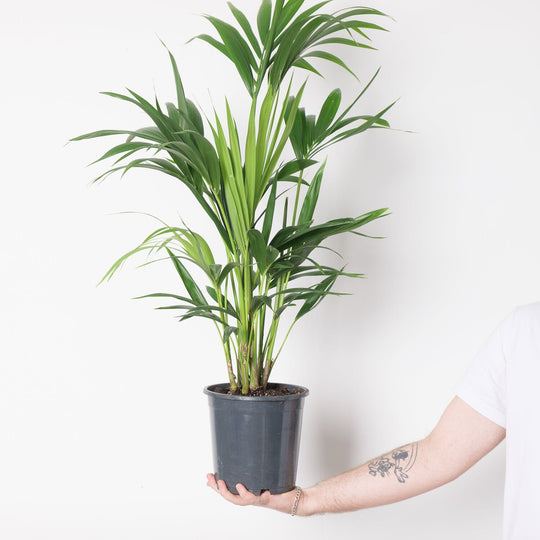
Why kentia palms are the best indoor palm
Many palms are sold as houseplants but few genuinely thrive indoors in the UK. Most need high light, high humidity, and warm temperatures year-round - conditions that are difficult to provide in a typical British home. The kentia palm is different. It evolved on a small, semi-shaded island and naturally tolerates lower light levels than most tropical palms. It copes with the dry air of centrally-heated rooms without the dramatic browning that afflicts other species. It grows slowly and stays in scale with typical room sizes for many years. And it is simply beautiful: the arching fronds with their elegant, drooping leaflets give any room an instant tropical ambience.
How to care for kentia palm
Kentia palms prefer bright, indirect light but will tolerate moderate shade - they are one of the most shade-tolerant large houseplants available. Avoid direct harsh sunlight, which scorches the fronds. Water when the top half of the compost feels dry, allowing excess to drain freely. Reduce watering in winter. Brown leaf tips (the most common issue) are caused by dry air, fluoride in tap water, or irregular watering. Try using filtered or rainwater if brown tips are persistent. Feed monthly from spring to early autumn with a palm-specific or balanced liquid fertiliser.
Size and growth rate
Kentia palms are slow growers - this is one of their virtues as a houseplant, as it means a large plant retains its proportions for many years. Young plants in 17-21 cm pots are ideal for desks and surfaces. Mid-sized plants in 24-30 cm pots are excellent floor plants. Large specimens in 35 cm+ pots can reach 2-3 metres indoors and make truly impressive statement plants. Growth rate is around 20-30 cm per year in good conditions, much slower in lower light.
Repotting and long-term care
Kentia palms dislike frequent repotting - repot only when the root system is clearly visible through the drainage holes or roots are circling heavily at the base. Move up by one pot size only, using a well-draining palm or houseplant compost. Never cut or damage the main roots. Kentia palms can develop a clustering multi-stemmed habit when multiple seeds germinate together - this multi-stemmed form is particularly lush and desirable. Remove dead or brown fronds by cutting cleanly at the base of the stem.