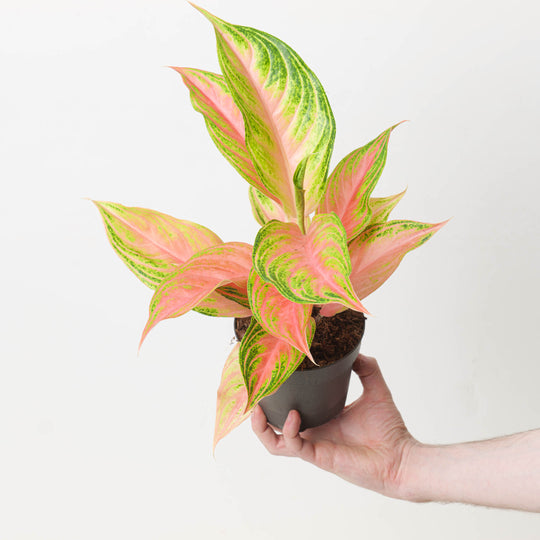
Money Tree
Pachira Care Guide

The Pachira aquatica, commonly sold as the Money Tree, is one of the easiest tropical trees to keep indoors. It has a braided trunk, palmate leaves shaped like an open hand, and a tidy upright habit that works in most rooms. The single most important thing to know: it does not want to be watered on a schedule. Let the compost dry partway down between drinks, and it will be a long-lived, low-fuss plant.
This guide covers light, watering, soil, repotting, propagation, varieties worth knowing, and the problems we get asked about most often.
Light Requirements for a Money Tree
The ideal light for Pachira aquatica is bright, indirect light. An east-facing window is the sweet spot, where the plant gets gentle morning sun and soft light for the rest of the day. A position a metre or two back from a south-facing window works just as well, as the distance takes the edge off the midday sun before it reaches the leaves.
Where the money tree earns its reputation as an easy houseplant is its tolerance. Pachira aquatica copes with medium light better than most tropical trees, which is why we tag it as happy in lower light. It will keep going in a spot that would sulk a Ficus into dropping half its leaves. The trade-off is pace rather than survival: in lower light the growth slows right down, new leaves emerge smaller, and the plant gradually becomes leggier as it stretches for the window. It will not collapse, but it will not be at its best either, so treat lower light as something it tolerates rather than something it prefers.
The plant will tell you when the light is wrong, and it is worth learning to read the signs. Too little light shows up as long bare gaps between leaves, weak floppy stems that lean hard toward the window, and foliage that turns a paler, washed-out green. Too much direct sun shows up on the leaves that face the glass, which develop bleached or scorched patches where the light has burned through the thin leaf tissue. In both cases the fix is simply to move the plant, brighter for the first set of symptoms, and back from the window or behind a sheer curtain for the second.
One last habit worth adopting: give the pot a quarter turn every week or two. Money trees lean toward their light source surprisingly quickly, and regular rotation keeps the canopy growing evenly instead of lopsided.
How Often to Water a Money Tree
The rule is simple: water when the top 3 to 5 cm of compost feels dry, then water thoroughly and let the excess drain out fully before the pot goes back on its saucer. In a warm, bright spot that usually works out at roughly every 7 to 10 days in summer, stretching to every 2 to 3 weeks in winter when growth slows and the compost dries far more slowly. Treat those numbers as a starting point rather than a schedule, though. The finger test beats the calendar every time, because light, temperature and pot size all change how fast the compost dries.
Pachira aquatica is sometimes described as a swamp plant because it grows along tropical riverbanks in the wild, and that description causes more dead money trees than any pest. In a pot indoors, it is not a swamp plant. A riverbank has constantly moving, oxygenated water; a pot has a fixed volume of compost that turns stagnant when it stays wet. Indoors, this plant is far more often killed by sitting in soggy compost than by going slightly dry, so when in doubt, wait another day or two.
Overwatering announces itself clearly if you know what to look for. Watch for yellowing lower leaves, a sour smell from the soil, soft black patches near the base of the trunk, and sudden leaf drop. The trunk symptoms matter most, because that thick braided stem stores water, and once it turns soft the rot is already well established. If you see any of these signs, act straight away rather than waiting to see if it improves. Take the plant out of its pot, check the roots, trim away any that are mushy or black with clean scissors, and repot into fresh, free-draining mix. Then water sparingly until you see new growth.
Underwatering is far less dangerous and far easier to fix. The signs are dry, crispy leaf edges, soil pulling away from the sides of the pot, and leaflets curling inward before they drop. When compost dries out completely it can become water-repellent, so a normal watering just runs straight through without soaking in. Instead, bottom water: sit the pot in a few centimetres of water for half an hour so the compost rehydrates evenly from below, let it drain, and then return to the normal cycle. The plant's water-storing trunk means it bounces back from a missed watering far more gracefully than from a fortnight of wet feet.
Soil and Potting Mix
Pachira needs a free-draining mix that holds some moisture but never stays sodden. Those thick roots and that water-storing trunk evolved for riverbanks where water arrives and then moves on, so the roots want air around them between drinks. A dense mix that stays wet suffocates them, and root rot follows no matter how carefully you water.
We suggest using our Jungle Mix or Simply Houseplant as the base, with a couple of handfuls of pumice stirred through for extra drainage.
Repotting
Repot every two to three years in spring, going up one pot size only. Pachira aquatica has a relatively small root system for the size of the canopy, so it prefers being slightly snug. A pot that is too large holds extra wet soil and pushes the plant toward root rot.
The pot matters as much as the mix. Always use one with drainage holes, and resist the urge to go dramatically oversized: a pot much bigger than the root ball holds a large volume of wet compost the roots cannot reach, and that spare compost sits there staying soggy. One size up from the current pot is plenty. Use a pot with drainage holes to prevent root rot.