


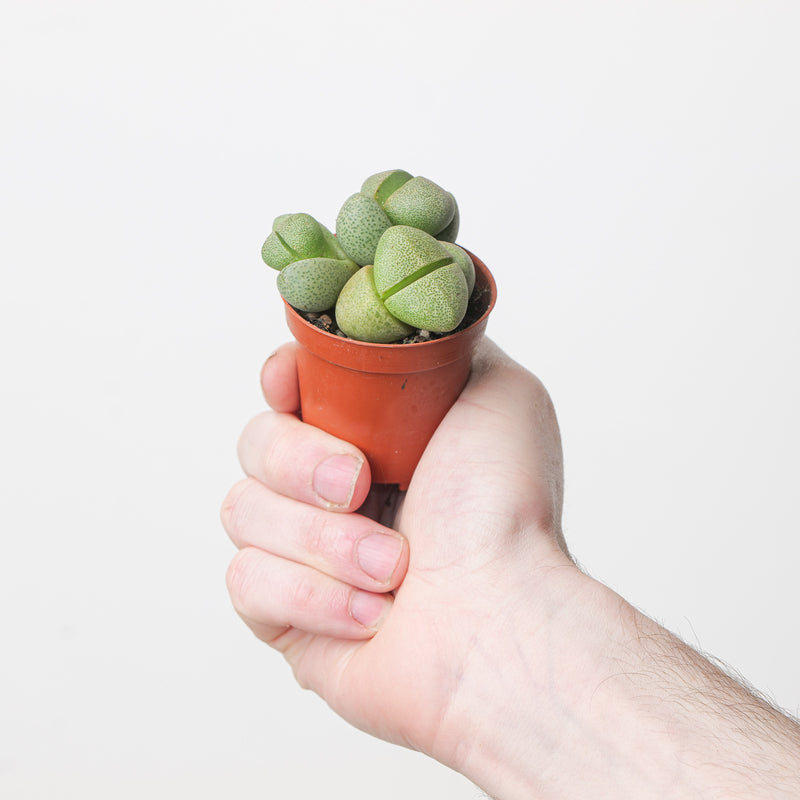
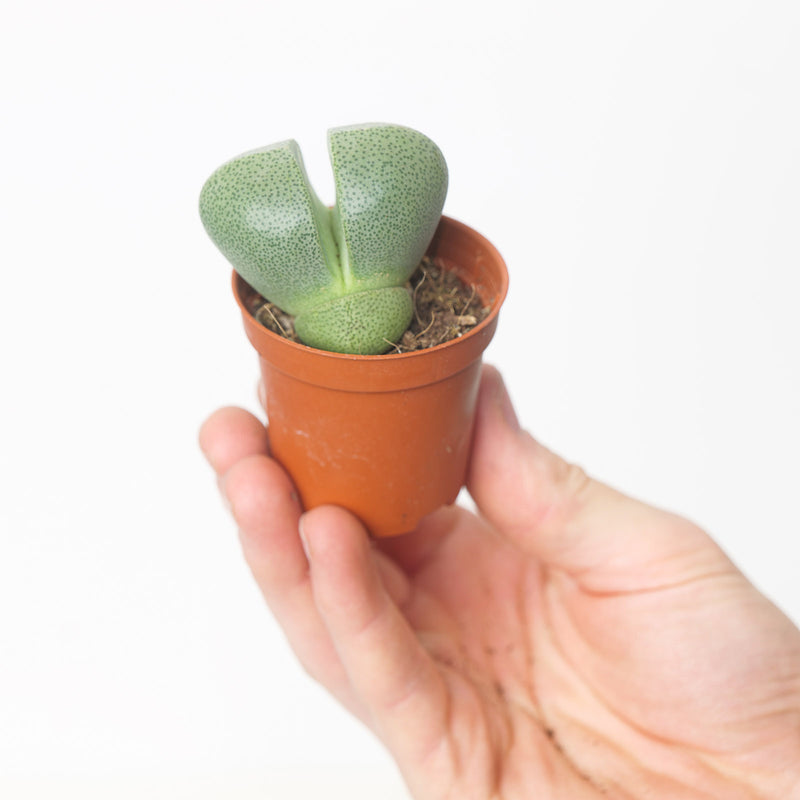

Pleiospilos nelii is a dwarf, stemless succulent native to the semi‑arid regions of the Karoo in South Africa It typically forms two or four thick, fleshy leaves, often grey‑green to brown, with small dark spots and a deep central cleft giving the appearance of a split stone, a camouflage adaptation in its habitat. A new pair of leaves grows from the centre each year, absorbing the older leaves.
In cultivation, it remains compact. around 5–10 cm tall and up to 10 cm across, and produces relatively large daisy‑like flowers, typically yellow to orange, about 6–7 cm wide, that open in late winter to spring (or late summer/autumn in some regions), often in the afternoon, closing at night.
Origins
Pleiospilos nelii is native to the Karoo and Eastern Cape regions of South Africa, where it grows in gritty, mineral-rich soils among quartz pebbles and low scrub.
Soil and Substrate
Pleiospilos nelii is extremely sensitive to overwatering and will quickly split, rot, or stack new leaves prematurely if kept too moist. Our Desert Mix is the right choice for this plant.


